
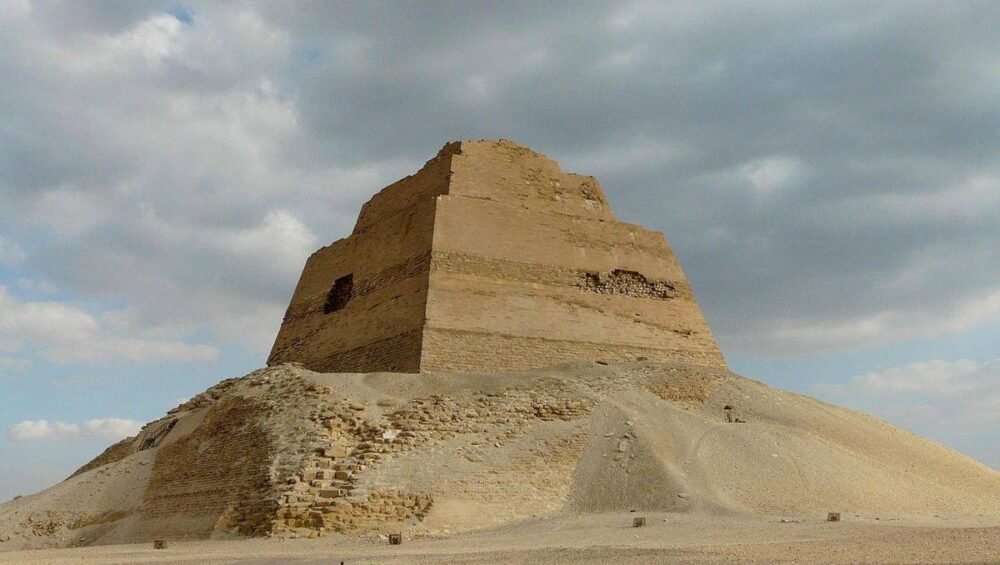
The Meidum Pyramid: The Mysterious Transformation of Egypt’s Early Monuments
Rising from the edge of the desert near El Fayoum, the Meidum Pyramid is an enigma shrouded in the sands of ancient Egypt. Often overshadowed by its more famous siblings in Giza, this pyramid tells a story of transition, engineering ambition, and the experimental spirit that shaped Egypt’s monumental history. Known as the ‘collapsed pyramid,’ Meidum stands as one of the earliest attempts to perfect the classic form we associate with pharaonic power. Believed to have been begun by Pharaoh Huni, the last ruler of Egypt’s Third Dynasty, and later completed—or reengineered—by his son, Sneferu, the Meidum Pyramid marks a crucial evolutionary stage from step pyramids to smooth-sided masterpieces.
When you first catch a glimpse of Meidum, it stands like a massive tower rising from the desert plain—a haunting reminder of both human achievement and failure. The once-layered steps, now partially buried under rubble, give it a surreal appearance. Archaeologists have long debated whether the collapse occurred during construction or centuries later, but its silhouette alone evokes the ingenuity and mystery of ancient builders. Visiting the Meidum Pyramid is like peering directly into the mind of the ancient architects who dared to reach for the heavens. It’s not just an archaeological site; it’s a revelation of the technological breakthroughs and missteps that paved the way for the majestic Pyramids of Giza.
Today, the Meidum Pyramid offers travelers and historians alike a chance to witness one of ancient Egypt’s most fascinating turning points. It rests quietly about 100 kilometers south of Cairo, beckoning the curious to explore its deserted corridors and tumble-down stones. The structure may not glitter like the Sphinx or the temples of Luxor, but its story is no less captivating. For those drawn to the origins of Egyptian architecture and the kingdom’s earliest visionaries, the Meidum Pyramid is a must-see treasure that unites the art of design with the timeless question of human ambition.
Historical Background of the Meidum Pyramid
The Meidum Pyramid dates to around 2600 BC and represents one of Egypt’s earliest large-scale attempts to create a true pyramid. It was initially conceived as a step pyramid, similar to the iconic one at Saqqara, attributed to Djoser. Scholars believe that Pharaoh Huni began the construction late in his reign and that Sneferu, known for his architectural innovations and the father of Khufu, transformed it into a smooth-sided pyramid. This modification, however, may have led to the structural instability that caused part of its collapse. The pyramid’s story thus stands at the crossroads of design evolution—from the crude step prototypes to the flawless geometries achieved later at Dahshur and Giza.
Sneferu’s projects were the laboratory of Egypt’s architectural genius. After Meidum, he built the Bent Pyramid and the Red Pyramid at Dahshour, perfecting the form that would define Egypt’s golden era. The Meidum Pyramid’s fall was no mere failure—it was the stepping stone toward mastery. Ancient builders learned hard lessons in weight distribution, angle calculation, and stone placement that would guide pyramid construction for centuries. To this day, the monument serves as a tangible reminder of humankind’s early struggle between vision and reality.
Architectural Features and Symbolism
The Meidum Pyramid was originally composed of seven steps, later expanded to eight, and then encased in a smooth limestone shell. This transitional architecture embodies a huge leap in engineering design. Inside, a narrow descending passageway leads to a central burial chamber set deep within the structure. Although now empty, this chamber was likely intended to hold the pharaoh’s spirit, ensuring his ascension to the gods. Early historians noted that the corridors’ alignment mirrored the cosmic pathways believed to link earth and the afterlife—an idea central to ancient Egyptian religion and architectural symbolism.
The material used was primarily limestone quarried from nearby Fayoum, a region famous for its ancient building resources and lush oases. The pyramid’s angle of inclination, nearly 51 degrees, proved too steep for the encasing stones to hold—yet that misstep birthed perfection in the next generation of pyramids. This curvature adjustment is exactly what Sneferu applied successfully to his masterpieces. The Meidum Pyramid thus remains an invaluable transitional model in understanding pyramid evolution, bridging the experimental zeal of early dynasties with the engineering precision of the Fourth Dynasty’s zenith.
The Collapse: A Mystery of Time and Technique
The question of why Meidum partially collapsed persists as one of Egyptology’s great puzzles. Some experts claim the outer casing slipped away during or shortly after construction. Others suggest centuries of erosion and earthquakes loosened the stones. Interestingly, the internal core remains largely intact, indicating that the failure lay not in overall design but in execution—a tragic consequence of experimentation. The massive mound surrounding the pyramid today, covering its base, is composed of the fallen casing stones, creating the illusion of a monument emerging from a sandstorm frozen in time.
Recent studies, using 3D scanning and ground-penetrating radar, reveal signs of stabilizing efforts made by ancient engineers—suggesting that even the builders recognized the structural risks. The fact that Sneferu continued with two more pyramid constructions afterward demonstrates both his determination and Egypt’s thirst for innovation. Unlike static relics, Meidum feels alive—a dialogue between past ambitions and modern rediscovery.
Surrounding Complex and Temples
Adjacent to the pyramid lies a wide courtyard flanked by an offering chapel, once adorned with reliefs of the king’s name and titles. Though now weathered, these remnants mirror early examples of the mortuary complexes that became integral to later royal burials. Just beyond stands a series of mastabas—rectangular tombs belonging to royal family members and officials. These structures offer invaluable insights into the craftsmanship, burial customs, and artistic conventions of the time. Together they form an archaeological ensemble that deepens our understanding of the shift from step pyramids to grand mortuary temples like those found in Luxor Temple and Abu Simbel.
Visiting the Meidum Pyramid Today
Travelers lucky enough to visit Meidum encounter a surreal sense of solitude. The site attracts far fewer crowds than Giza, making it ideal for those seeking quiet reflection among timeless ruins. A day trip from Cairo or Fayoum offers the opportunity to explore its terraces and inner passages, witnessing the earliest efforts of a civilization learning to move mountains—literally. Combining a Meidum visit with nearby destinations like the oases of Fayoum Oasis or the natural beauty of Wadi Al Hitan creates a journey rich in contrast and wonder.
Guided excursions such as Day Tour to El Fayoum from Cairo or private Cairo Day Tours often include Meidum, giving visitors a deeper appreciation of Sneferu’s architectural footprint. Many seasoned explorers recommend timing your visit for late afternoon when the sunlight bathes the remaining tiers in a warm golden glow, emphasizing the pyramid’s haunting majesty.
Archaeological Discoveries and Preservation Efforts
Excavations around Meidum have uncovered numerous artifacts—tools, pottery shards, and funerary stelae—that tell of ancient workers and priests who maintained this site across dynasties. Early 20th-century excavations led by Flinders Petrie documented the pyramid’s structural components in great detail, revealing the meticulousness of Old Kingdom engineering. Preservation remains an ongoing challenge; wind erosion and shifting sands continue to threaten the stability of exposed stones. Projects supported by the Egyptian Ministry of Antiquities aim to strengthen the pyramid’s base, clear debris, and improve access paths without altering its ancient character.
Modern-day adventurers often connect a Meidum exploration with broader Egypt Day Tours that trace the progression of pyramid architecture across the country—from Sakkara Necropolis to Memphis and onward to the resplendent Grand Egyptian Museum. These comparisons reinforce the Meidum Pyramid’s role as the missing link between early conceptual models and polished perfection.
Legacy of the Meidum Pyramid in Egyptian Architecture
The Meidum Pyramid’s legacy lives on in every limestone block of Giza. Without Sneferu’s experiments here, the precision of Khufu’s Great Pyramid might never have existed. The lessons learned from Meidum—especially regarding slope, foundation, and casing—redefined architectural strategies in subsequent centuries. Beyond its physical form, Meidum represents a profound shift in cultural psychology: the realization that even divine projects require human adaptation and engineering logic.
In the broader timeline of Egyptian art, Meidum coincides with emerging sophistication in sculpture and carving. Statues discovered nearby exhibit realistic proportions and expressive features, heralding a stylistic maturity that paralleled architectural advances. These works exemplify the harmony between form and function that became hallmarks of Old Kingdom aesthetics.
FAQs about the Meidum Pyramid
What makes the Meidum Pyramid different from other pyramids in Egypt?
The Meidum Pyramid stands out as a transitional structure between step and true pyramids. It’s unique in its collapsed form, which provides insight into the experimental phase of Egyptian pyramid construction. The transformation initiated by Sneferu showcases early attempts to achieve the smooth-sided design perfected later at Dahshur and Giza.
Who built the Meidum Pyramid?
Archaeological evidence attributes the Meidum Pyramid to Pharaoh Huni, the last ruler of the Third Dynasty, with major reconstruction by his successor, Sneferu. Their collaboration symbolizes the turning point in ancient engineering, bridging earlier step forms with the classic pyramid silhouette.
Can visitors enter the Meidum Pyramid?
Yes, visitors can enter through a narrow descending passage leading to the burial chamber. The interior offers a remarkable look at early architectural design and provides a more intimate experience than the more crowded sites in Giza. Tours from Cairo often include guided access with safety supervision.
Where is the Meidum Pyramid located?
The pyramid lies about 100 kilometers south of Cairo, near the modern village of Meidum and the lush fields bordering El Fayoum. Its isolated position adds to its mystique, contrasting with the busy tourist hubs of northern Egypt.
What other attractions are near the Meidum Pyramid?
Nearby attractions include the verdant Fayoum Oasis, the ancient ruins of Qasr Qarun Temple, and the stunning fossil beds of Wadi El Rayan. The combination of archaeological wonder and natural beauty makes any visit to the Meidum Pyramid an unforgettable journey through Egypt’s forgotten landscapes.