
Dandara Temple: A Timeless Jewel of Ancient Egyptian Civilization
Nestled on the western bank of the Nile River near Qena, Egypt, the Dandara Temple—also spelled Dendera Temple—stands as one of the most captivating sanctuaries of ancient Egyptian architecture. This mesmerizing site, primarily dedicated to Hathor, the goddess of love, music, and motherhood, captures the essence of spiritual devotion and artistic mastery that flourished during Egypt’s Greco-Roman period. Stepping into the Dandara Temple complex feels like entering a time capsule, where the vibrant paintings remain astonishingly vivid, and the hieroglyphic inscriptions whisper stories of gods, kings, and cosmic order. It’s no exaggeration to say that this temple is one of the best-preserved monuments in Egypt, rivaling its more famous counterparts in Luxor Temple and Edfu Temple.
Beyond its grand design, the Dandara Temple offers a unique glimpse into how ancient Egyptians fused astronomy, mythology, and religion. The temple’s ceilings once held the original zodiac of Dendera, a celestial map that remains one of Egyptology’s greatest discoveries. Every column, every relief, reveals the remarkable precision and creativity of artisans who sought to honor their gods while chronicling cosmic cycles. A visit here isn’t just a historical detour—it’s a spiritual awakening draped in stone. For any traveler embarking on Luxor day tours or Egypt day tours, this spectacular site deserves a top spot on the itinerary.
The Mythological Significance of the Dandara Temple
Dandara Temple’s heart beats with the energy of Hathor, one of ancient Egypt’s most beloved deities. In mythology, Hathor symbolized fertility, joy, and protection, yet she also held divine power as the celestial mother and consort of Horus. The Dandara complex was more than a place of worship—it was an earthly manifestation of the goddess’s nurturing spirit. Ancient Egyptians celebrated festivals here that included music, dance, and lavish banquets in Hathor’s honor. The energy of devotion still lingers within its halls, mirroring other divine sites such as the Temple of Hathor and Abydos Temple.
The temple’s ceiling showcases striking depictions of the night sky, where constellations highlight the divine connection between heaven and earth. The famous Zodiac of Dendera, now displayed in the Louvre, once adorned this sacred roof, revealing how Egyptians mapped celestial patterns for ritual and agricultural purposes. Each scene on the temple walls conveys intricate tales of cosmic rebirth, where Hathor’s energy restored balance to the universe—a concept echoed throughout Egyptian theology.
Architectural Brilliance and Sacred Geometry
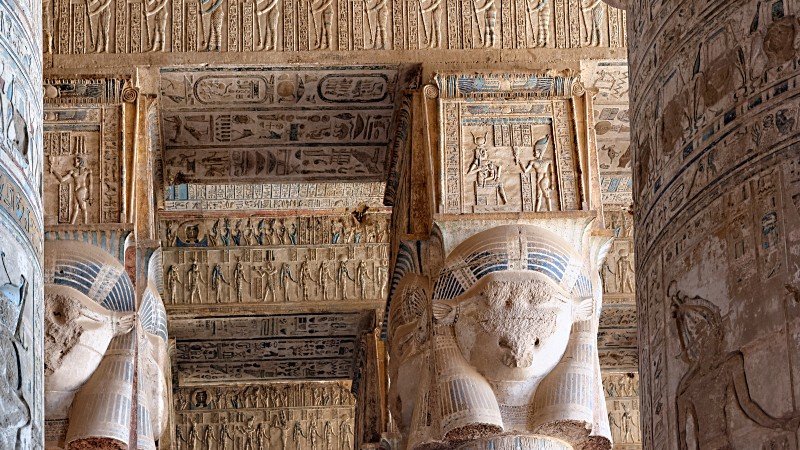
The layout of Dandara Temple exemplifies sacred symmetry. Constructed predominantly during the reigns of Ptolemy XII and Roman Emperor Tiberius, the temple’s design follows traditional Egyptian forms blended with Greco-Roman influences. The massive entrance gateway leads into a hypostyle hall supported by twenty-four majestic columns decorated with Hathor’s face—her serene features representing universal love and music. Exploring this hall feels like standing in a symphony carved into stone, similar in grandeur to the Dendera Temple Complex.
Each corridor reflects a calculated alignment to astronomical phenomena. The temple faces directly toward the Nile, a symbolic gesture representing the eternal connection between the river’s fertility and divine blessing. Behind the main sanctuary are multiple chapels, including those dedicated to Osiris, Isis, and Horus—emphasizing Dandara’s importance as a center for multiple cults. The subterranean crypts, filled with delicate carvings and sacred texts, amplified the temple’s mystical aura.
The Zodiac of Dendera: A Celestial Masterpiece
Perhaps no feature of the Dandara Temple garners more fascination than its Zodiac relief. The Dendera Zodiac, a circular representation of the stars, reveals how ancient Egyptian astronomers understood the heavens long before modern astronomy. Depicted with symbols similar to the Greek zodiac but grounded in Egyptian cosmology, it shows the gods governing celestial time. Many scholars consider it a map of divine order, indicative of the temple’s dual role as a place of worship and observatory. Visitors intrigued by this cosmic symbolism should also explore the Nile River, whose cycles guided temple rituals and offerings.
Reliefs, Inscriptions, and the Preservation of Ancient Art
The vivid quality of Dandara’s reliefs is astonishing. Unlike many other temples, the colors inside remain strikingly vibrant. Shades of blue, green, gold, and red illuminate scenes depicting Hathor’s music festivals, healing rituals, and offerings performed by pharaohs. Hieroglyphics line the walls with remarkable precision, narrating hymns and sacred chants dedicated to Hathor and Osiris. Observers can even spot scenes showcasing the pharaohs’ divine anointment ceremonies, echoing similar ritual depictions found in the Temple of Hatshepsut.
Conservation efforts have helped maintain this masterpiece against centuries of decay. Inside, the ceilings once blackened by soot have been meticulously cleaned to reveal their intricate celestial artistry. This preservation makes the Dandara Temple not only a historical gem but also an invaluable cultural treasure for future generations.
The Spiritual Energy and Symbolism of Dandara
Walking through the temple feels charged with an almost palpable spiritual current. Dandara was believed to radiate cosmic harmony, making it an essential site for healing and regeneration. Hathor’s role as a goddess of joy extended into fertility rites and musical ceremonies performed here, filling the temple with song and incense. The sacred lake within the complex served purification rituals for priests before ceremonies began. Visitors today often describe the temple as profoundly spiritual—a place where time itself seems to pause in reverence. Many travelers include Dandara Temple on their route through Luxury Nile Cruise itineraries to capture its tranquil aura beyond the bustle of modern Egypt.
Traveling to Dandara Temple: How to Experience It
Located about 60 kilometers north of Luxor, Dandara is easily accessible through guided excursions or Nile cruises linking iconic stops such as Kom Ombo Temple and Temple of Philae. Many travelers choose packages that bundle Dandara and Abydos for a full-day cultural dive into ancient mythology. If time allows, the private tour to Dandara and Abydos from Luxor offers an intimate, well-paced itinerary that blends expert narration with unhindered exploration.
Visiting during early morning hours ensures cooler weather and the chance to admire the temple’s artistry in natural light streaming through its entrances. Combining this experience with other Upper Egypt highlights—like the Ramesseum Temple or Colossi of Memnon—creates a holistic journey through Egypt’s enduring spiritual legacy.
Best Time to Visit and Travel Tips
The ideal time to tour Dandara Temple is between October and April when daytime temperatures stay moderate. Travelers should bring water, sunscreen, and a camera to capture the intricate carvings in gentle sunlight. Consider pairing the adventure with nearby sites accessible through organized Egypt vacation packages that include expert guides and transportation arrangements. For those inspired by deeper immersion, a 4-day Luxor, Edfu, Kom Ombo, Aswan and Abu Simbel tour provides a fantastic route combining the Nile’s great sanctuaries and archaeological marvels.
The Dandara Light Show and Modern Cultural Impact
Modern Egypt continues to honor Dandara’s rich legacy through restoration and cultural exhibits. Periodic light displays reenact ancient rituals with projected animation against the temple’s facade, demonstrating how history fuses with modern storytelling. For travelers enchanted by multimedia presentations, the Sound and Light Show at Karnak Temples also captures the grandeur of Egypt’s sacred architecture.
Legacy of Hathor and Dandara through the Ages
Even as dynasties rose and fell, Dandara Temple maintained its sacred importance. Early Christians adapted portions of the complex for their worship, integrating new iconography alongside ancient carvings. Later, archaeologists rediscovered it nearly intact, marveled at its preservation, and recognized it as a temple that bridged antiquity with continuity of faith. Hathor’s legacy evolved into an emblem of compassion and divine artistry that continues to inspire researchers, spiritual seekers, and artists alike. Her serene visage atop each column reminds us that beauty and devotion can coexist in timeless balance.
Exploring Nearby Attractions
After exploring Dandara Temple, visitors can extend their journey to neighboring wonders. The celestial grandeur of Abydos complements Dandara’s earthly grace, while Luxor hosts countless marvels like the Luxor Museum and Valley of the Queens. These destinations together form an essential chapter in any comprehensive tour of ancient Egypt, filled with powerful mythology, artistic mastery, and soul-stirring spirituality. For ultimate comfort and immersion, travelers may opt for an elegant river journey like the Nour El Nil Dahabeya.
Frequently Asked Questions about Dandara Temple
What is the Dandara Temple famous for?
Dandara Temple is renowned for its remarkable preservation, intricate carvings, and the breathtaking Dendera Zodiac—a depiction of the night sky that merges Egyptian and Greco-Roman astronomy. It’s also celebrated as the main cult center of Hathor, the goddess of love, joy, and motherhood.
Where is Dandara Temple located?
The Dandara Temple lies near Qena in Upper Egypt, approximately 60 kilometers north of Luxor along the western bank of the Nile River. It’s easily accessible through private tours or Nile cruise excursions.
When was the Dandara Temple built?
The temple’s main structures were built during the late Ptolemaic Period and completed in the early Roman era, particularly under the reigns of Ptolemy XII and Tiberius. However, earlier foundations date back to the Old Kingdom, making it a multi-era cultural site.
Who was Hathor, and why was she worshipped here?
Hathor was one of Egypt’s most adored deities, symbolizing love, music, fertility, and maternal care. The Dandara Temple served as her primary sanctuary, where priests and pilgrims honored her divine compassion through music and elaborate festivals.
Can visitors explore the entire Dandara Temple complex?
Yes, much of the temple remains open to the public, including its hypostyle hall, inner sanctuaries, underground crypts, and rooftop chapels. Visitors can admire the vivid colors, hieroglyphic texts, and architectural wonders firsthand—making it a highlight of any Upper Egypt itinerary.