
Temple of Hathor at Dendera – A Timeless Gem of Ancient Egyptian Spirituality
Standing proudly on the western bank of the Nile in Qena Governorate, the Temple of Hathor at Dendera is one of Egypt’s most mesmerizing archaeological treasures. Dedicated to Hathor, the goddess of love, music, beauty, and motherhood, this temple reflects the profound artistry and spiritual symbolism of ancient Egyptian civilization. The Dendera complex, part of the larger Dendera Temple Complex, offers visitors an enchanting experience rich with mythological narratives, intricate carvings, and awe-inspiring astronomical significance. Whether you’re a history buff, culture enthusiast, or traveler captivated by Egypt’s charm, this ancient sanctuary delivers a spectacle like no other.
Unlike many temples that suffered from natural decay or human interference, the Temple of Hathor stands remarkably well-preserved. Its colossal columns, intricately painted ceilings, and sacred crypts reveal the depth of devotion ancient Egyptians felt for their goddess. Every wall here seems alive, echoing melodies played thousands of years ago in honor of Hathor, often seen as the protector of joy and harmony. This sacred site is not just another monument—it’s a poetic masterpiece where myth and mystery converge in architectural perfection.
Today, traveling to Dendera is easier than ever. Many Luxor Day Tours and Nile Cruise itineraries include this extraordinary temple. Whether you embark on a 4 Day 3 Night Nile Cruise from Aswan to Luxor or choose a Private Tour to Dendera and Abydos from Luxor, stepping into the Temple of Hathor feels like entering a living time capsule where divine energy still hums beneath the sandstone walls.
The History and Construction of the Temple of Hathor at Dendera
The Temple of Hathor showcases an evolution of Egyptian architecture spanning pharaonic, Ptolemaic, and Roman eras. Although its foundations trace back to Old Kingdom times, the present structure was primarily built during the reign of Ptolemy XII and completed by the Roman Emperor Tiberius. The temple pays homage not only to the goddess herself but also to the concept of universal balance—Hathor being the divine mother who bridges heaven and earth.
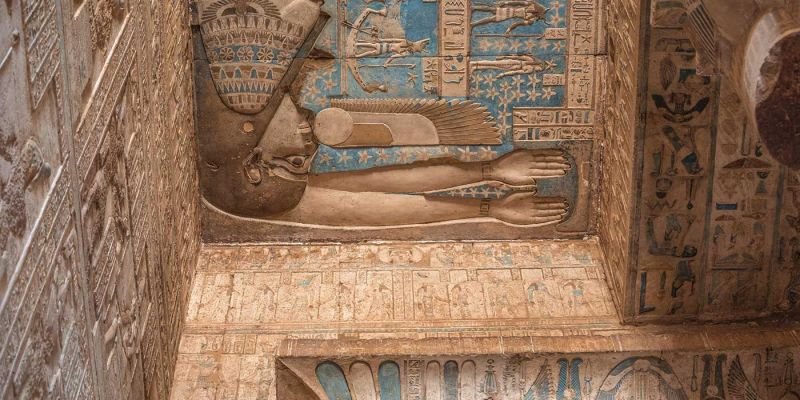
Architecturally, Dendera embodies symmetry and spirituality. The main temple, surrounded by mudbrick walls, houses inner sanctuaries, hypostyle halls, osirian chapels, and even underground crypts used for sacred relics. The hypostyle hall alone boasts 24 columns, each crowned with a stunning Hathor-headed capital, symbolizing her watchful presence throughout the complex. Colorful ceiling panels depict celestial deities and astronomical scenes, including the renowned Dendera Zodiac, a masterwork illustrating the ancient Egyptians’ understanding of the cosmos.
Visitors today can wander through passageways once reserved for the high priestess of Hathor, ascend stairways leading to the temple roof, and marvel at ritual rooms where sacred ceremonies were held under moonlit skies. The craftsmanship reveals exceptional precision, blending hieroglyphic narratives with divine symbolism that continues to captivate modern Egyptologists and travelers alike.
Mythological Importance of Hathor in Ancient Egypt
Hathor’s cult flourished for millennia due to her wide-ranging influence in daily life and spirituality. She was known as the ‘Mistress of the West,’ greeting souls into the afterlife, and the celestial ‘Lady of the Stars,’ connecting earthly beauty with the eternal heavens. Myths link her closely with Ra, the sun god, and Horus, son of Isis and Osiris. In essence, Hathor represented the feminine divine—nurturing yet powerful, sensual yet sacred.
In this temple’s reliefs, Hathor is depicted nursing Horus, dancing among sistrums, or blessing pharaohs with eternal love. Such images transcend mere decoration; they mirror society’s belief in divine reciprocity and joy through devotion. The Dendera complex, therefore, stood not only as a sanctuary but also as a cosmic stage where divine drama and human life intertwined seamlessly.
The Dendera Zodiac – Celestial Marvel of the Temple
One of Dendera’s most fascinating artifacts, the Dendera Zodiac, once adorned the ceiling of a chapel dedicated to Osiris on the temple’s roof. Its celestial map features an exquisite circular design depicting constellations such as Leo, Taurus, and Aries. It’s an astronomical treasure that reveals how ancient Egyptians aligned cosmic patterns with their gods and rituals. Although the original artifact now resides in the Louvre Museum, a perfect replica remains at Dendera, providing visitors insight into the civilization’s early understanding of astrological cycles.
Astrologers, historians, and even modern travelers find this zodiac compelling for its symbolic depth and artistic finesse. It encapsulates a worldview in which divinity and the universe operated in unity—an idea that echoes through Egyptian religion, philosophy, and architecture across centuries. Many travelers pair their exploration of this masterpiece with a Nile Cruise from Luxor to Aswan to explore other temples like Temple of Hatshepsut, Edfu Temple, and Kom Ombo Temple—each representing different aspects of divine philosophy.
Rituals and Festivals in the Temple of Hathor
Every year, ancient priests celebrated the Festival of the Beautiful Reunion, when the statue of Hathor from Dendera traveled by boat along the Nile to meet Horus in Edfu. This grand event symbolized divine marriage and cosmic harmony, filling the riverbanks with music, dance, and offerings. The temple’s halls once echoed with chants and the rhythmic rattle of sistrums dedicated to Hathor’s joy. Today, while the rituals have ceased, you can almost hear the echoes of devotion in the still air—proof of the goddess’s enduring influence on Egypt’s spiritual identity.
Exploring the Sacred Architecture and Underground Crypts
The Temple of Hathor isn’t just visually stunning—it’s steeped in mystery beneath its surface. The crypts beneath the temple floor contain hieroglyphic reliefs illustrating sacred symbols, such as the famous “Dendera Light” carvings, interpreted by some as representations of divine energy or the creation myth itself. Each figure and inscription in these chambers carried religious significance intended only for the eyes of priests.
Ascending to the temple’s rooftop reveals chapels dedicated to Osiris, with breathtaking celestial frescoes and offering tables used during ancient ceremonies. These spaces were designed for rituals celebrating the resurrection of Osiris, emphasizing life, death, and rebirth—themes central to both Hathorian and Osirian cults.
Visiting the Temple of Hathor Today
Whether you’re exploring Egypt Day Tours or embarking on extended Egypt Vacation Packages, visiting Dendera is a must-do. Located approximately 60 km north of Luxor, it’s accessible via scenic Nile journeys or organized excursions. Many visitors prefer combining Dendera with Abydos, another sacred site revered for its Temple of Seti I. These twin temple visits provide an in-depth look into Egypt’s ancient theology and architectural mastery.
Modern travelers often comment on the calm atmosphere compared to more crowded sites like Karnak or Luxor Temple. Here, you can wander leisurely, marvel at intricate ceiling paintings still vivid after two thousand years, and even photograph the Hathor-headed capitals glowing under golden sunlight. A stop in Dendera allows you to step beyond tourist circuits and experience the serene heart of ancient Egyptian religion. It’s no surprise that it’s a highlight on routes like the 7 Days Cairo and Nile Cruise Package or 11 Days Luxury Egypt Tour Package.
Best Time to Visit and Travel Tips
The ideal season for exploring the Dendera complex is from October to April when temperatures are mild, making archaeological tours more comfortable. Morning visits allow travelers to enjoy unobstructed sunlight streaming through columns, enhancing the vividness of reliefs and carvings. Guides with expertise in hieroglyph interpretation bring the walls to life with fascinating legends, while photographers capture the temple’s luminous artistry against the Nile backdrop.
Including Dendera in your itinerary, along with a stop at Abu Simbel Temples or Luxor Temple, enriches any cultural tour of Egypt. Combining sacred sites gives you a perspective on how religion shaped dynastic rule, art, and astronomy across centuries. For the ultimate experience, consider pairing your temple tour with a Luxury Dahabiya Nile Cruise to witness these wonders from the gentle waters of the Nile itself.
FAQs about the Temple of Hathor at Dendera
1. Where is the Temple of Hathor located?
The Temple of Hathor is located in Dendera, about 60 kilometers north of Luxor, on the west bank of the Nile River in Qena Governorate, Egypt. It’s part of the magnificent Dendera Temple Complex, which also includes smaller chapels and shrines dedicated to other deities.
2. Why was the Temple of Hathor built?
The temple was constructed to honor Hathor, goddess of love, joy, motherhood, and music. It served as a major center for her worship and hosted annual festivals such as the Beautiful Reunion, symbolizing her union with Horus from Edfu. The complex also housed rituals tied to fertility and cosmic balance.
3. What makes the Temple of Hathor unique among Egyptian temples?
Unlike other temples, Dendera’s structure features exceptional preservation and incredibly detailed ceiling art. The Dendera Zodiac, intricate crypt reliefs, and the richly colored astronomical scenes make it a standout example of spiritual architecture and cosmic symbolism.
4. Can visitors enter the underground crypts?
Yes, some crypts beneath the Temple of Hathor are open to visitors under supervision. They reveal sacred reliefs and symbolic carvings that portray religious rituals and cosmic themes. Access depends on preservation conditions and tour permissions.
5. How can travelers visit the Temple of Hathor from Luxor?
Most travelers take guided excursions from Luxor, often as part of Luxury Egypt Tours or Egypt Private Tours. You can also book a Day Tour from Luxor or an extended cruise itinerary that includes Dendera and Abydos. These organized journeys provide historical insights while ensuring comfort and convenience.


