Dendera Temple Complex – The Sacred Jewel of Hathor in Ancient Egypt
Nestled on the west bank of the Nile, a few miles north of Luxor City, the Dendera Temple Complex stands as one of Egypt’s best-preserved temples dedicated to Hathor, the goddess of love, music, and joy. This archaeological gem pulls travelers, historians, and archaeologists into a world where divine craftsmanship meets celestial inspiration. Known for its stunning reliefs, astronomical ceiling, and secret crypts, Dendera embodies the mysterious allure of ancient Egyptian spirituality. The temple exudes an aura of divine energy, guiding visitors through the architectural beauty and sacred rituals that once animated this magnificent structure.
The Dendera Temple Complex isn’t just a tourist destination; it’s a living testament to Egypt’s spiritual sophistication, where art, astronomy, and theology interlace seamlessly. Built primarily during the Ptolemaic period, with portions extending into the Roman era, this complex signifies the last great flourishing of ancient Egyptian religion before Christianity reshaped the landscape. Inside its walls lie traces of pharaohs, priests, and deities whose stories defy time. From the famous Zodiac ceiling to the enigmatic sanctuaries beneath, each chamber evokes awe.
Today, visitors exploring Egypt through Luxury Egypt Tours or Egypt Vacation Packages often find Dendera to be one of the highlights of their journey—a place that effortlessly blends romance, history, and architectural mastery. Whether you arrive from Aswan Day Tours or take a scenic cruise along the Nile, the first glimpse of Hathor’s temple bathed in golden desert light will leave you spellbound.
Historical Origins and Significance of the Dendera Temple Complex
The Dendera Temple Complex holds an esteemed place among the temples of Upper Egypt. Dedicated primarily to Hathor, one of the most revered Egyptian deities, the site’s religious significance predates the Ptolemaic era, tracing back at least to the Old Kingdom. The earliest ruins suggest that this location sustained continuous spiritual use for more than 4,000 years. Pharaoh Pepi I and later rulers contributed to earlier shrines that predated the current Ptolemaic structure.
The temple we see today began during the reign of Ptolemy VIII and continued through Cleopatra VII’s era. The blending of traditional Egyptian design with Greco-Roman artistic influences demonstrates a fascinating cultural syncretism that enriched Egyptian religious architecture. Hathor, often depicted as a woman with cow horns and a solar disc, represented love, fertility, music, and maternal protection—qualities deeply woven into ancient Egyptian life and myth.
Scholars often compare Dendera’s design to other sacred monuments such as the Temple of Hathor and the Abydos Temple, both exemplifying the religious symbolism and astronomical accuracy cherished by pharaonic architects. Inscriptions throughout Dendera proclaim its role as a cosmic temple aligned with celestial cycles—highlighting the intricate unity between heaven and earth.
Architectural Grandeur and Symbolic Design
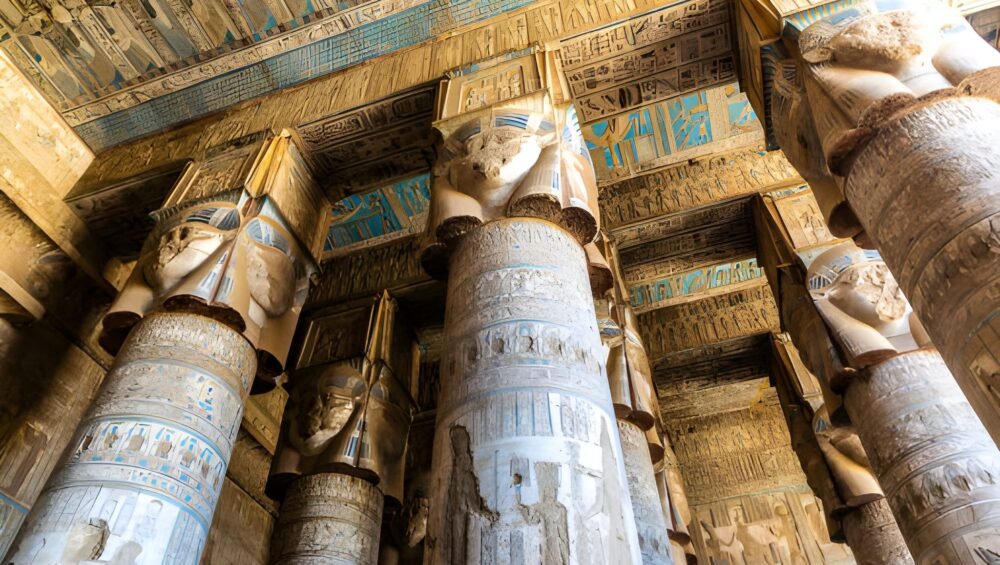
Dendera’s imposing structure spans nearly 40,000 square meters, enclosed by a mudbrick wall that once protected a complete sanctuary complex including chapels, birth houses, and a sacred lake. Its main temple, dedicated to Hathor, reflects classical Egyptian architecture fused with artistic refinements unmatched in later periods. Massive columns crowned with Hathoric capitals—featuring the goddess’s face and cow ears—dominate the great hypostyle hall.
The façade, adorned with intricate carvings, narrates the divine rituals performed by pharaohs, emphasizing their eternal bond with the gods. Inside, seven chapels honor various deities, including Osiris, Horus, and Isis, intertwining the mythic narratives of love, death, and resurrection. Hieroglyphic inscriptions blanket every surface, telling tales of sacred offerings and cosmic renewal. Visitors often marvel at how precisely engineers aligned the temple to the rising sun during significant solar events, symbolizing Hathor’s life-giving light.
For those captivated by architectural brilliance, Dendera surpasses imagination—whether one explores after a journey on the 4 Day 3 Night Nile Cruise from Aswan to Luxor or as part of a stand-alone excursion like the Private Tour to Denderah and Abydos from Luxor, the temple’s scale and precision continue to enthrall.
The Famous Zodiac Ceiling
Arguably, the Dendera Zodiac is one of the temple’s most breathtaking features. Originally adorning the ceiling of a chapel dedicated to Osiris, the Zodiac represents the ancient Egyptians’ profound knowledge of astronomy and their attempt to map the cosmos. This circular relief charted star constellations and celestial phenomena, serving as both a timekeeping device and a mythological symbol of rebirth. The original artifact now resides in the Louvre Museum, but the replica at Dendera continues to awe spectators with its intricate detail and astrological complexity.
The Zodiac links the Dendera Temple Complex to cosmic order, reaffirming the ancient belief that the temple itself was a microcosm of the universe. It reflected humanity’s ongoing dance with divine creation—each celestial movement mirrored through Hathor’s compassionate eyes.
The Crypts and Hidden Chambers of Dendera
Beneath the temple lies a labyrinthine network of crypts and passageways that once safeguarded sacred statues, papyri, and elaborate ritual instruments. Priests accessed these hidden spaces to perform mysterious ceremonies aligned with the temple’s celestial purpose. Some crypts contain exquisite reliefs showing the procession of divine emblems, while others harbor enigmatic symbols, including what some interpret as ancient representations of light sources—the so-called “Dendera Light.” Though debated, these carvings embody the temple’s enigmatic aura, sparking fascination among researchers and mystical theorists alike.
These subterranean corridors amplify the Dendera Temple Complex’s mystique, drawing curious travelers seeking Egypt’s secret knowledge. Exploring these chambers often leaves visitors speechless, feeling an almost sacred hush echoing through the air.
The Birth House (Mammisi) and Sanctuaries
The temple’s birth house, or Mammisi, celebrates the divine birth of Ihy, son of Hathor and Horus. Rituals performed here reenacted cosmic renewal, emphasizing fertility and the cyclical nature of life. Intricate carvings portray deities attending the divine childbirth, symbolizing regeneration and the perpetuation of maat, or universal harmony.
Each sanctuary within Dendera carries its own mythological resonance, from the Osirian chapels to the ceremonial rooftop where priests conducted New Year celebrations marking the union of Hathor and Horus. Visitors standing on the roof can imagine the rhythmic chants and musical ceremonies that once filled these sacred spaces with celestial harmony.
Astronomy, Symbolism, and Mystical Interpretations
Dendera wasn’t merely a religious site—it served as an astronomical and cosmological observatory. Celestial alignments guided rituals, new year festivals, and navigation of agricultural cycles. The temple’s architecture perfectly embodies ancient Egypt’s union of science and spirituality. Every wall reflected the universe’s rhythm, merging the earthly with the divine.
Intriguingly, scholars have compared the Dendera inscriptions with those found in other ancient temples like Edfu Temple and Kom Ombo Temple, highlighting how Dendera preserved a purer, more detailed vision of Egyptian cosmology. The motifs of stars, deities, and cosmic boats symbolize the cyclical journey of the sun and souls alike.
For spiritual seekers, Hathor’s temple remains a living symbol of joy, beauty, and enlightenment. Its walls whisper timeless truths, teaching that every rhythm of the cosmos resonates within the human heart.
Why Visit the Dendera Temple Complex Today?
Visiting Dendera is like stepping into an art-filled universe carved in stone. The complex lies conveniently near modern Qena, making it accessible on multiple itineraries such as Luxor Day Tours, Egypt Day Tours, or luxurious journeys aboard the Steigenberger Minerva Nile Cruise. The temple’s grandeur attracts photographers, historians, and travelers eager to experience a preserved piece of ancient divinity.
Whether during sunrise, when golden rays illuminate Hathor’s serene smile, or under moonlight revealing the mystical reliefs, Dendera promises an unforgettable encounter with Egypt’s spiritual heritage. Combining visits here with other sacred sites like the Luxor Temple or the Temple of Hatshepsut enriches a journey of discovery through ancient Egypt’s monumental landscape.
Travel Tips for Exploring Dendera
Travelers are encouraged to visit early in the morning to avoid the afternoon heat and enjoy the serenity that amplifies the temple’s spiritual resonance. Hiring a local Egyptologist guide enhances the experience, offering insights often missed by untrained eyes. Carry water, wear a hat, and bring a camera—every wall and inscription here deserves to be captured.
Most importantly, take your time within Hathor’s presence. The Dendera Temple Complex rewards patience—every relief hides a story, every chamber holds a secret. Exploring it through tailored packages like the 8 Days Best Egypt Tour with Nile Cruise or 11 Days Luxury Egypt Tour Package ensures comprehensive immersion into Egypt’s timeless wonders.
FAQs about the Dendera Temple Complex
Where is the Dendera Temple Complex located?
The Dendera Temple Complex lies about 60 kilometers north of Luxor, near the modern city of Qena in Upper Egypt. Its strategic location along the west bank of the Nile made it a vital religious and cultural hub throughout ancient history.
Who was the Dendera Temple Complex dedicated to?
The main temple within the Dendera complex is dedicated to Hathor, the goddess of love, music, beauty, and motherhood. Other structures in the complex honor deities such as Horus and Isis, reflecting a rich pantheon of divine relationships.
When was the Dendera Temple Complex built?
Construction began during the reign of Ptolemy VIII in the 2nd century BCE and was completed under Roman emperors such as Tiberius. However, earlier temples dating back to the Old Kingdom also existed on this sacred ground.
Why is the Dendera Zodiac important?
The Dendera Zodiac is an exceptional astronomical artifact depicting ancient Egyptian constellations and celestial events. It reveals how Egyptians observed and integrated cosmic phenomena into their religious practices, emphasizing the temple’s role as a cosmic mirror of the universe.
Can tourists visit the Dendera Temple Complex today?
Yes, the Dendera Temple Complex is open to the public year-round. Many tours from Luxor and Qena include it as part of broader itineraries, often combined with sites like Abydos Temple for a comprehensive exploration of ancient Egyptian spirituality.