The Majestic Ramesseum Temple: A Testament to Pharaoh Ramses II’s Eternal Legacy
Standing with commanding grace on the West Bank of Luxor, the Ramesseum Temple embodies the grandeur, ambition, and architectural prowess of ancient Egypt. Built by Pharaoh Ramses II during the 19th Dynasty, this colossal memorial temple served not only as a tribute to his divine rule but also as a beacon of religious devotion to Amun-Ra. Every stone block carved into the Ramesseum whispers the tales of conquest, devotion, and divine connection that defined Egypt’s golden era. Visitors today wander through time, marveling at the colossal statues, vast courtyards, and hieroglyph-covered walls that depict scenes from Ramses II’s military triumphs.
The temple’s ruins still convey overwhelming majesty, even though centuries of Nile floods and time have eroded its symmetry. Designed as part of the Theban Necropolis, opposite modern Luxor, the Ramesseum was among several mortuary temples aligning with rebirth beliefs in the afterlife. Its striking resemblance to the Luxor Temple reveals the consistent artistic vision of New Kingdom architects, blending devotion, propaganda, and pure aesthetic beauty. As the sun sets on the ancient sandstone, golden light filters across statues of Ramses II, making the Ramesseum one of Egypt’s most soul-stirring archaeological treasures.
For modern travelers exploring with curated Luxor Day Tours or immersive Nile cruise programs, the Ramesseum offers a refreshing detour from mainstream attractions, allowing a moment of awe and reflection. With its fallen colossus that once stood 20 meters tall and intricate carvings inspired by the Battle of Kadesh, this temple continues to stand as a powerful reminder of human creativity, ambition, and devotion to immortality. Whether you’re a history enthusiast, an adventurer, or a seeker of spiritual connection, the Ramesseum Temple will leave an indelible mark on your journey through ancient Egypt’s timeless wonders.
Origins and Purpose of the Ramesseum Temple
The Ramesseum Temple, commissioned by Ramses II—often hailed as Ramses the Great—was meticulously designed to honor both the king and the god Amun-Ra. Construction began around 1279 BCE, and its architectural layout reflects a syncretic fusion of religion, artistry, and royal propaganda. Much like the Abu Simbel Temples, it symbolized divine kingship and celebrated Ramses II’s reign as both ruler and deity. This temple served dual purposes: functioning as a house of worship and a mortuary complex intended to perpetuate the king’s cult after death.
The grand design included pylons engraved with battle scenes from the famous Battle of Kadesh, which glorified Ramses II’s might and divine favor. Beyond its political symbolism, the Ramesseum also mirrored the Egyptian concept of Ma’at—the balance of order and cosmic harmony. As visitors walk through its monumental gateways, they trace the same pathway that ancient priests took to perform rituals meant to sustain the pharaoh’s eternal soul. In many ways, the Ramesseum embodies the ideological essence of New Kingdom Egypt, blending religion, art, and politics into a masterpiece that has withstood the passage of time.
Architectural Brilliance and Symbolic Alignment
The Ramesseum Temple’s architecture is a marvel of symmetry, symbolism, and ambition. Built primarily from limestone and sandstone, it once featured massive colonnades, sprawling courtyards, sanctuaries, and storerooms. The temple’s axis aligns perfectly with cardinal points, symbolizing cosmic balance and harmony with celestial forces. The first pylon, now partially collapsed, displayed vivid reliefs depicting Ramses II riding his chariot into the thick of battle—a stellar example of ancient Egyptian bas-relief artistry. Beyond it lies the peristyle court adorned with colossal statues that once towered over viewers, showcasing Ramses II as a god among men.
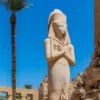
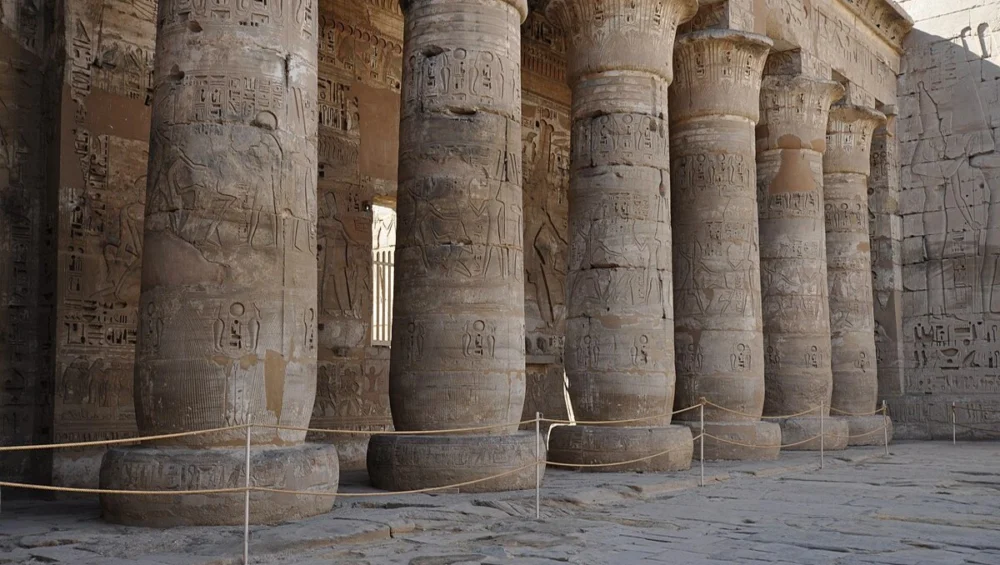
Inside the hypostyle hall, the grandeur continues. Forty-eight papyrus-shaped columns rose toward intricately decorated ceilings, each adorned with scenes of offerings, processions, and divine adoration. The temple’s inscriptions describe Ramses II’s devotion to Amun-Ra, Osiris, and Ra-Horakhty, emphasizing the divine lineage that justified his reign. Remarkably, fragments of the fallen colossus—once among the largest in Egypt—remain on site, a poignant testament to ancient craftsmanship rivaling masterpieces such as the Sphinx Statue in Giza.
The Artistic Legacy and Carvings of Ramses II’s Greatness
Every inch of the Ramesseum’s walls was meant to speak to eternity. Reliefs chronicle military victories, offering scenes to the gods, and symbolic celebrations of divine power. The Battle of Kadesh series remains its central highlight—one of the earliest known historical battle depictions, rich with motion, detail, and propaganda. Artists captured the king’s chariot charging into enemy ranks with divine composure, overseen by the gods who bestowed protection and courage.
Perhaps most fascinating is how these walls also reflect domestic and cosmic serenity. Scenes showing agricultural activities, priestly rituals, and offerings underscore Egypt’s cyclical harmony. The juxtaposition of warfare and peace captures the duality that governed Ramses II’s image: warrior and protector, destroyer and creator. The Ramesseum thus stands not merely as a building but as an open stone book narrating divine-human interaction.
The Temple’s Unique Influence on Classical and Modern Culture
Although partially in ruins, the Ramesseum Temple has profoundly influenced global literature, art, and archaeology. In the 19th century, the colossal fallen statue of Ramses II inspired poets and explorers alike. The British poet Percy Bysshe Shelley famously drew inspiration for ‘Ozymandias,’ a work that immortalized the impermanence of human ambition. Scholars, too, continue to uncover fascinating insights into construction methods and ritual significance here, tying the Ramesseum’s design to other wonders like the Temple of Hatshepsut and the Habu Temple nearby.
Modern travelers exploring the temple often extend visits to participate in local experiences such as the Day Tour to Ramesseum Temple, Habu Temple, and Nobles Valley, immersing themselves in the atmosphere that once echoed with ancient prayers and rituals. Each crumbling statue and engraved wall unveils a layer of ancient art that resonates with Egyptologists and romantics alike, emphasizing humanity’s unending desire to be remembered through art, belief, and architecture.
Preservation, Excavation, and Modern Tourism
Archaeological teams from around the world have spent decades documenting and restoring portions of the Ramesseum, ensuring its legacy transcends time. Advanced conservation techniques have stabilized column reliefs and protected inscriptions from erosion. Agencies and heritage experts work closely to balance tourism and preservation, keeping the structure accessible while safeguarding it for future generations. Travelers often combine their visit to the Ramesseum with a serene Nile River cruise, discovering neighboring marvels like the Colossi of Memnon and the Temple of Seti.
Preservation programs also focus on illuminating the temple’s spiritual context, especially its connection to funerary rituals. By studying artifacts discovered in inner chambers, researchers gain rare insight into Ramses II’s theology and the evolving relationship between kingship and divinity. The Ramesseum, despite its ruined state, still guards invaluable knowledge that binds the modern world to ancient Egypt’s spiritual heart.
Ramesseum Temple: Location, Layout, and Visitor Experience
Nestled near the Luxor City on the west bank of the Nile, the Ramesseum lies among the clustered jewels of the Theban Necropolis. Surrounded by sand dunes and the serene westward drift of the Nile breeze, its sacred location was meticulously chosen to reflect eternity—the domain of the setting sun where the spirits of kings were believed to dwell. Visitors stepping onto this hallowed ground are instantly transported into an atmosphere steeped in grandeur and divine reverence.
The temple’s layout guides visitors progressively inward—from grand courtyard to hypostyle hall to the inner sanctum—symbolizing a spiritual journey from the earthly realm to the divine. Today, guided explorations, often part of Egypt Vacation Packages, allow tourists to decode the hieroglyphic inscriptions under expert narration. The towering columns, scattered colossal statues, and elaborate reliefs create an immersive open-air museum echoing with ancient hymns and footsteps of priests who once tended the sacred fires.
Symbolism of the Ramesseum and Its Spiritual Role
For ancient Egyptians, the Ramesseum Temple served as a vital bridge between the mortal and divine worlds. It hosted daily rituals, offerings, and festivals dedicated to Amun-Ra, promoting the pharaoh’s eternal sustenance through divine energy. The statues of Ramses II portrayed him as Osiris—the resurrected god of the underworld—strengthening the belief that the temple secured his immortality. The ceremonial alignment of halls and sanctuaries embodied ancient cosmological principles where light, order, and eternity converged.
Even today, visitors feel the pull of that powerful symbolism. Many travelers combine exploration of the Ramesseum with enriching stops such as the magnificent Dandara Temple and intimate local tours like the Luxor Hot Air Balloon Ride, catching early morning glimpses over the ruins as the Nile shimmers below—the same view Ramses II himself might have admired millennia ago.
Practical Travel Insights and Recommendations
For travelers seeking to explore Egypt beyond the obvious highlights, the Ramesseum Temple stands as a rewarding detour—serene, less crowded, and mesmerizingly authentic. Located about 25 minutes from central Luxor, it’s easily accessible via organized Egypt Day Tours. Early mornings or late afternoons are ideal for visiting, as soft sunlight illuminates the reliefs, emphasizing the delicate craftsmanship lost beneath midday shadows.
Visitors often integrate their journey into larger multi-day itineraries, combining this temple with fascinating excursions such as the 4 Day Cairo and Luxor Tour Package or luxury cruise options like the Steigenberger Royale Nile Cruise. Standing amidst the sand-swept courtyards, visitors can almost sense the rhythm of ancient hymns echoing against massive columns—a perfect moment to lose oneself in Egypt’s eternal allure.
Interesting Facts About the Ramesseum Temple
One of the lesser-known facts is that the Ramesseum was originally called ‘The House of Millions of Years of Usermaatre-Setepenre,’ Ramses II’s throne name. At its peak, the temple complex included not only worship halls but also granaries, schools, and archives that documented agricultural production and royal endowments. Archaeologists have discovered remnants of statues, papyri, and sculptures offering glimpses into temple administration and priestly life. The temple’s library, one of the earliest documented in Egypt, contained texts on medicine, poetry, and theology—truly a sanctuary of knowledge and spirituality.
The Enduring Legacy of the Ramesseum Temple
Though time and natural elements have partly dismantled its glorified façade, the Ramesseum persists as a living chronicle of Egyptian civilization. Its architectural genius paved the way for later innovations seen in the Temple of Philae and Edfu structures. For historians, it’s a reminder of Egypt’s unmatched creative ambition; for travelers, it remains an enchanting chapter of humanity’s timeless fascination with eternity.