The Magnificent Mosque of Ibn Tulun: Egypt’s Timeless Islamic Masterpiece
In the heart of historic Cairo lies one of Egypt’s most enduring treasures — the Mosque of Ibn Tulun. As the oldest mosque in Cairo still retaining much of its original form, this monumental site stands as a masterpiece of early Islamic architecture and devotion. Built in the 9th century, its grandeur, vast courtyard, and spiral minaret have fascinated travelers for centuries. The mosque doesn’t just tell a story of piety; it narrates an extraordinary chapter of Egyptian and Islamic heritage. For anyone exploring Islamic Cairo, visiting the Mosque of Ibn Tulun offers a glimpse into an era when artistry, geometry, and faith intertwined seamlessly to create one of Egypt’s most captivating monuments.
More than being a mosque, it’s a living remnant that bridges ancient inspirations from Samarra with Cairo’s evolving urban identity. This remarkable structure remains an active place of worship while simultaneously serving as a stunning historical landmark. Its open-air courtyard framed by elegant arches, subtle Kufic inscriptions, and ornate stucco work invites visitors to pause and breathe in over a millennium of spirituality and architectural excellence. The story of Ibn Tulun, a visionary governor who commissioned this sanctuary, blends ambition, culture, and an enduring passion for legacy — one that continues to echo through the mosque’s resonant halls even today.
Nearby attractions, like the Citadel of Salah El-Din and the Al Azhar Mosque, create an intricate network of Islamic landmarks, making the Mosque of Ibn Tulun a vital stop in any Cairo Day Tour. A journey through its vast corridors evokes the legacy of early Islamic Egypt — a civilization grounded in art, faith, and architectural innovation.
Historical Origins of the Mosque of Ibn Tulun
The Mosque of Ibn Tulun traces its roots back to 876–879 AD, commissioned by Ahmad Ibn Tulun, the founder of the Tulunid dynasty. This was a time when Cairo, then known as al-Fustat, was emerging as a beacon of Islamic leadership. Ibn Tulun envisioned a mosque that would not only accommodate large congregations but would also serve as a powerful representation of his authority and refined taste. The result was a monumental complex capable of hosting thousands, rivaling the grand mosques of Baghdad and Damascus.
Ahmad Ibn Tulun’s decision to build his mosque atop the ‘Jabal Yashkur,’ or Hill of Thanksgiving, was no random choice. According to local lore, this very hill is where Noah’s Ark came to rest after the floodwaters receded. Whether by myth or design, the symbolism perfectly suits a sanctuary of gratitude and worship.
During your exploration of Islamic Cairo or while booking a Coptic and Islamic Cairo Tour, you’ll quickly realize that the Ibn Tulun Mosque is not merely old — it’s a living testament to Cairo’s layered evolution through centuries of faith and artistry.
Architectural Inspiration: From Samarra to Cairo
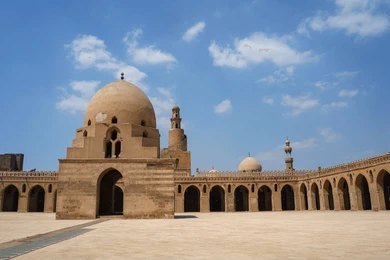
The architecture of the Mosque of Ibn Tulun draws heavily from the Abbasid style of Samarra, featuring expansive courtyards, pointed arches, and the signature spiral minaret. Its clean lines and geometric harmony reflect early Islamic architectural principles emphasizing simplicity and divine unity. The red brick and gypsum materials, along with its ingenious design, make it one of the largest mosques in Africa still intact from its original construction.
The mosque’s horseshoe arches and elaborately carved stucco panels display the artistic depth of the Tulunid era. The open-air sahn (courtyard) surrounded by riwaqs (arcades) embodies balance and serenity, contrasting beautifully with the hubbub of Cairo outside its walls. Visitors stepping through its gates are often struck by the tranquil silence, a striking shift from the city’s rhythm.
The Iconic Spiral Minaret: A Symbol of Innovation
Among the most distinctive features of the Mosque of Ibn Tulun is its spiral minaret, inspired by Iraq’s Great Mosque of Samarra. This helix-shaped tower ascends gracefully from a square base, allowing worshippers to climb it via an external staircase. The minaret offers stunning panoramic views of Old Cairo, stretching toward landmarks like Sultan Hassan Mosque and the Al Rifai Mosque. This unique design wasn’t just an aesthetic statement but also served practical purposes — guiding the muezzin’s call to prayer across early medieval Cairo.
The spiral minaret became an architectural marvel that influenced countless later mosques across the Islamic world. For architectural enthusiasts and travelers exploring Egypt through Luxury Egypt Tours, ascending the minaret is an unmissable experience, merging history, artistry, and an unbeatable view of Egypt’s ancient skyline.
Spiritual and Cultural Significance
The Mosque of Ibn Tulun isn’t just an architectural jewel; it’s a profound symbol of enduring spirituality. For centuries, it has been a place of meditation, prayer, and education. The structure’s simplicity captures the essence of early Islamic worship: direct, humble, and deeply personal. The central courtyard’s vast emptiness encourages reflection, while the rhythmic arrangement of arches draws the visitor’s gaze inward — toward the soul and the divine.
Within its walls, theology, philosophy, and science once converged, turning the mosque into a hub for scholars and artists. Many spiritual leaders considered the mosque’s purity of design a reflection of the Muslim relationship with God: infinite, symmetrical, and eternally balanced. For today’s travelers, standing inside the hall evokes the same awe Ibn Tulun himself must have felt over a millennium ago.
Preservation Through the Centuries
Unlike many historical structures in Cairo that underwent extensive modifications, the Mosque of Ibn Tulun miraculously remains largely unchanged since its completion. Restoration efforts by various rulers, including Sultan Lajin in 1296, helped reinforce the mosque’s integrity while maintaining its original spirit. Today, the mosque is protected as part of Cairo’s UNESCO World Heritage Islamic quarter, drawing historians, architects, and worshippers alike.
Nearby, visitors can explore landmarks like the Grand Egyptian Museum or embark on a Cairo City Tour to connect the mosque’s narrative to broader historical contexts, envisioning how Egypt’s faith and artistry continue to flourish side by side.
The House of Gayer-Anderson: A Glimpse into the Past
Adjoining the mosque stands the Gayer-Anderson Museum, a beautifully preserved Ottoman-era residence that complements the mosque’s story perfectly. Visitors can step inside its rooms, still filled with antique furniture, Islamic art, and decorative pieces collected by the British officer Gayer-Anderson in the 1930s. Together with the mosque, this museum paints a vivid portrait of Cairo’s changing cultural identity — a blend of Islamic heritage and colonial intrigue.
Many Egypt Private Tours integrate visits to both the Mosque of Ibn Tulun and the Gayer-Anderson House, providing a seamless journey through Egypt’s architectural and cultural splendor.
Architectural Symbolism and Design Philosophy
The mosque’s rectangular layout, with a central open courtyard surrounded by deep arcades, symbolizes both physical and spiritual openness. Every design aspect — from the alignment toward Mecca to the symmetrical arches — reflects deep mathematical precision and symbolic unity. The Kufic script carving verses of the Qur’an around the mosque exemplifies the sacred geometry that defines Islamic art at its purest form.
The mosque’s mihrab (prayer niche) and minbar (pulpit) were crafted using polished marble and delicately carved wood, emphasizing permanence and harmony. Ibn Tulun’s architects designed each feature to represent earthly humility and heavenly grandeur, merging earthly form with divine order — a concept mirrored at sites like Temple of Hatshepsut and Abu Simbel Temples, where spirituality and architecture intertwine seamlessly.
An Enduring Tourist Attraction
Today, the Mosque of Ibn Tulun attracts thousands of international visitors every year. Whether you’re on a quick day trip to Cairo or on an extensive itinerary like the 10-Day Cairo with Nile Cruise, this mosque should top your must-see list. Its quiet majesty offers a perfect retreat from Cairo’s energy, inviting travelers to walk in the footsteps of ancient voices echoing through sandstone corridors.
For added cultural depth, pair your visit with the nearby Islamic Cairo attractions or explore the surrounding streets filled with local crafts, coffeehouses, and old-world charm. The area remains one of the best-preserved examples of early Islamic urban design anywhere in the world.
FAQs About the Mosque of Ibn Tulun
Where is the Mosque of Ibn Tulun located?
The Mosque of Ibn Tulun is located in the Sayyida Zaynab district of Old Cairo, Egypt. It lies between the Citadel and the historic heart of Islamic Cairo, making it easily accessible on most tour itineraries or Egypt Day Tours.
Who built the Mosque of Ibn Tulun?
The mosque was built by Ahmad Ibn Tulun, the governor of Egypt under the Abbasid Caliphate. Constructed between 876 and 879 AD, it served both as a place of worship and as a statement of Tulunid independence and architectural innovation.
What is unique about the Mosque of Ibn Tulun’s design?
The Mosque of Ibn Tulun is famed for its vast open courtyard, pointed arches, and the distinctive spiral minaret — a design inspired by the Great Mosque of Samarra in Iraq. Its use of brick and stucco, along with minimal ornamentation, makes it a profound blend of beauty and restraint in Islamic architecture.
Can visitors enter the Mosque of Ibn Tulun?
Yes, tourists are welcome to visit the mosque throughout the week. Modest attire is expected, and entering during prayer hours offers a serene, authentic experience. Its tranquil ambiance provides a welcome escape from the bustling streets of Cairo.
Why should travelers include the Mosque of Ibn Tulun in their Egypt itinerary?
The mosque is one of the few remaining untouched gems of Islamic architecture in Egypt. It offers insight into 9th-century design, spirituality, and urban planning, making it an essential stop for cultural enthusiasts, historians, and first-time visitors exploring the wonders of Egypt Vacation Packages.