The Enigmatic Unfinished Obelisk: Egypt’s Most Astonishing Monument of Antiquity
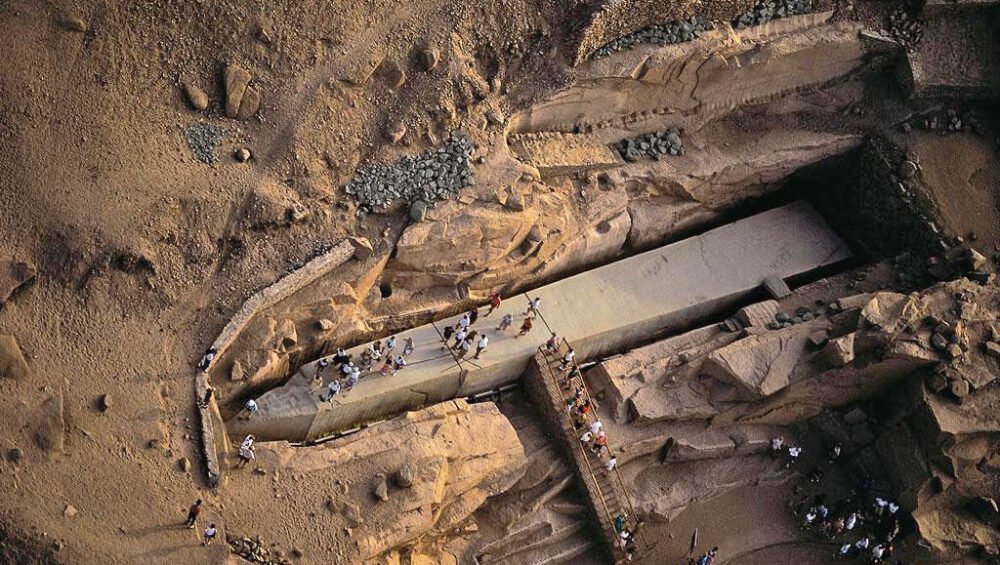
The Unfinished Obelisk in Aswan stands as one of Egypt’s most spellbinding archaeological marvels, frozen in time yet bursting with stories from the ancient world. This colossal monument — partially carved directly from Aswan’s rose granite quarries — offers a rare, candid glimpse into ancient Egyptian engineering, craftsmanship, and ambition. Measuring roughly 42 meters long and estimated to weigh over 1,200 tons, it would have been the single largest obelisk ever erected, dwarfing even those that grace the Luxor Temple and Karnak. Yet, the Unfinished Obelisk remains forever incomplete, abandoned when a fatal crack appeared midway through its carving process.
Located within the Northern Quarry of Aswan, where generations of ancient artisans chiseled massive stones destined for temples and pyramids, the Unfinished Obelisk offers a riveting narrative of ancient construction techniques. Long before cranes, hydraulic systems, or modern saws, workers harnessed copper tools, dolerite pounding stones, and ingenuity to carve these mammoth blocks. Their legacy lives on, etched into the grooves and tool marks that still line the obelisk’s surface.
For travelers diving into Egypt’s timeless treasure trove, this monument isn’t just a relic — it’s a window into the audacious vision of Pharaohs, notably Hatshepsut, who’s believed to have commissioned this masterpiece to honor the sun god Amun. Whether you’re exploring through one of the Aswan Day Tours or cruising the Nile with a Luxury Egypt Tour Package, witnessing the Unfinished Obelisk in person evokes awe, humility, and deep respect for a civilization that turned stone into enduring glory. With every chisel mark preserved through millennia, the site whispers the genius, labor, and heartbreak behind ancient Egypt’s monumental creations.
The Historical Significance of the Unfinished Obelisk
The Unfinished Obelisk holds unparalleled historic importance. Believed to date back to the 18th Dynasty under Queen Hatshepsut, its discovery revolutionized Egyptology. Not only does it shed light on ancient Egyptian quarrying and stone-working, but it also bridges the gap between grand monuments like the Temple of Philae and massive constructions along the High Dam of Egypt. The site became an outdoor laboratory where archaeologists could decode lost techniques — how Egyptians separated huge granite slabs from bedrock, shaped them, and prepared them for transportation along the Nile.
The obelisk was meant to accompany its twin, possibly erected at Karnak. Its monumental scale would have emphasized divine connection and political might. The decision to abandon it following the discovery of a structural crack isn’t just a tale of failure; it’s a testament to precision. The ancient builders understood the risks of flaws in granite that could compromise stability once erected. By examining this incomplete masterpiece, historians now grasp the immense technological intellect of Egypt’s engineers long before the Greek or Roman periods.
The Craftsmanship and Tools Behind Ancient Egyptian Engineering
Nothing about ancient Egyptian engineering was improvised. Every stroke of the dolerite hammerstone followed meticulous planning. Workers pounded at the granite surface endlessly, forming trenches around the obelisk to separate it from the bedrock. Stone pounding created a trench wide enough to insert wood or rope soaked in water, which upon expansion, slowly lifted the monolith from the ground. Standing in front of this 42-meter monument today, one feels the rhythm of that ancient labor echoing across millennia.
These methods became blueprints for countless structures to follow — temples, colossal statues, and even monuments such as the Abu Simbel Temples. The Unfinished Obelisk remains one of the few places on Earth where the quarrying process is still visible in situ. For travelers joining an Egypt Day Tour, visiting Aswan’s quarry connects myth, science, and artistry in one epic encounter.
Queen Hatshepsut’s Vision and the Symbolism of Obelisks
Obelisks symbolized the sun’s rays — massive granite beams pointing toward the heavens, representing divine connection between gods and humans. Queen Hatshepsut, one of Egypt’s most influential female Pharaohs, envisioned obelisks as both sacred and political declarations of glory. She commissioned multiple obelisks to mark her reign, proving supremacy through architectural mastery. This unfinished one was intended as her magnum opus, dedicated to Amun-Ra, the god of creation and light.
According to inscriptions and quarry evidence, the workers carved directly into the Aswan granite surface, demonstrating an unprecedented level of precision and coordination. Although it was never completed, its colossal size still embodies Hatshepsut’s unyielding ambition — a vision paralleled only by her mortuary temple at Deir el-Bahari.
Why the Obelisk Was Never Finished
While laborers were chiseling, a fatal crack appeared in the granite core, rendering the entire project useless. The discovery forced them to stop. The crack serves today as an archaeological archive, showing how even Egypt’s most skilled engineers faced nature’s limitations. The incomplete monument lay untouched, conserving technical mysteries for centuries. It offers clear proof of how large-scale failures shaped the evolution of architectural innovation throughout Egyptian history.
Today, walking along its length allows visitors to see the human-to-stone relationship — the pain, the perseverance, and the moment innovation met natural imperfection. It’s these haunting traces that make it a highlight for visitors exploring Aswan through Luxury Nile Cruises or Best Nile River Cruises.
The Unfinished Obelisk as a Living Museum in Aswan
Unlike many artifacts enclosed behind museum glass, the Unfinished Obelisk remains embedded within the very quarry from which it was born. Standing amidst Aswan’s pink-granite cliffs, visitors can trace thousands of chisel marks created by workers who likely lived in nearby camps. This open-air museum allows unparalleled contact with history. It’s not hard to imagine the clinking of hammerstones echoing, dust rising under a relentless sun, while overseers shouted instructions to synchronized teams of workers.
Today, Aswan’s tourism circuit integrates the quarry alongside attractions like Kalabsha Temple and The Nubian Museum. For modern travelers seeking authenticity, this site provides a raw, unfiltered encounter with ancient creativity — a real-life backstage pass to Pharaonic engineering brilliance.
Touring the Unfinished Obelisk: An Insider’s Guide
The best time to explore the Unfinished Obelisk is early morning, when Aswan’s golden light caresses the granite and shadows accentuate the chiseling lines. The site is easily accessible from downtown, often included in Aswan city tours. Many Nile cruises, such as the Steigenberger Minerva Nile Cruise or the Nile Premium Cruise, feature stops here as part of their excursions.
Visitors can meander through the quarry, examine ancient tool marks, and envision crew operations. Informational plaques explain how these obelisks were carved, polished, transported, and often stood as pairs in temple entrances — symbolizing harmony and balance. The site’s guides illuminate secrets of stonecutting and convey the awe ancient Egyptians must have felt as they labored at the dawn of human engineering.
Pairing Your Visit With Other Aswan Attractions
A visit to the Unfinished Obelisk blends seamlessly with exploring Aswan’s other archaeological landmarks. Don’t miss a boat trip to the sacred island housing the Temple of Philae, dedicate a day to the scenic Nubian Village, or take a serene Felucca Ride on the Nile. Each experience adds context to the Unfinished Obelisk’s story, illuminating how religion, craftsmanship, and the natural world intertwined in lower Nubia.
Aswan also serves as a launchpad to visit majestic southern masterpieces like the Abu Simbel Temples. The juxtaposition between the massive completed monuments and the uncompleted obelisk reveals fascinating duality — ambition versus constraint, triumph versus flaw — defining Egypt’s eternal narrative.
Modern Preservation and Archaeological Efforts
Egypt’s Ministry of Antiquities continues to safeguard the Unfinished Obelisk as a national treasure. Restoration teams monitor weathering, employ laser scanning for digital preservation, and promote the site’s sustainable tourism. Today’s researchers leverage the obelisk’s unfinished nature to reconstruct ancient methods of fracture detection and vibration analysis. The monument thus serves modern science while nurturing Egypt’s tourism economy.
Inclusion of this site in curated programs like the Egypt Vacation Packages or 8 Days Best Egypt Tour with Nile Cruise ensures both its global visibility and protective oversight.
FAQs About the Unfinished Obelisk
Where is the Unfinished Obelisk located?
The Unfinished Obelisk lies within Aswan’s Northern Quarry, near the modern city center. Aswan is southern Egypt’s granite capital, supplying stone for temples and pyramids throughout Egyptian history. The site can be easily reached by car or taxi from any central hotel or part of Aswan Transfers itineraries.
Who commissioned the Unfinished Obelisk?
Most scholars credit Queen Hatshepsut, the 18th Dynasty’s celebrated Pharaoh, for commissioning the Unfinished Obelisk. It was likely intended to complement another obelisk erected at the Temple of Karnak, representing her divine partnership with Amun-Ra and reflecting Egypt’s architectural peak.
Why did the ancient Egyptians abandon it?
While carving, a structural crack developed in the granite, compromising the entire monument’s integrity. Quarry engineers realized it couldn’t stand safely. Rather than risk construction failure, they abandoned it, leaving behind a living testimony of Egypt’s trial and error in monumental artistry.
What makes the Unfinished Obelisk unique among ancient monuments?
Unlike completed obelisks that showcase finished polish and inscriptions, this monument displays every step of its creation — rough grooves, tool imprints, and cutting channels. Its incompleteness offers a transparent insight into ancient Egyptian engineering, rarely found elsewhere in archaeological history.
Can tourists visit the Unfinished Obelisk today?
Yes. The site welcomes visitors daily, with guided tours that explain its history, purpose, and techniques. Most Egypt Private Tours include it within Aswan itineraries, often paired with excursions to Philae Temple, the High Dam, and the Nubian Museum for a comprehensive cultural immersion.
The Unfinished Obelisk stands unmatched as both a marvel and a mystery — a silent reminder of humanity’s reach toward perfection and the natural limits that define it. Even in its cracked slumber, it continues to inspire, teaching generations that glory often lies not only in completion, but in the effort itself.