Red Monastery in Sohag: A Coptic Masterpiece of Early Christian Egypt
Nestled on the western bank of the Nile near Sohag, the Red Monastery—known locally as Deir Anba Bishai—stands as one of Egypt’s most stunning examples of Coptic Christian architecture. Its name comes from the reddish hue of its burnt-brick walls, which glow warmly under the desert sun. Steeped in nearly sixteen centuries of devotion, art, and monastic discipline, this ancient sanctuary remains an extraordinary reminder of Egypt’s deep Christian heritage. Through meticulous restoration, the monastery has emerged as a vibrant testimony to early monastic life, making it an essential highlight for history enthusiasts and pilgrims visiting Upper Egypt. Whether you’re tracing the footsteps of hermit monks or admiring the dazzling frescoes, the Red Monastery offers a journey back to an era when faith shaped art and architecture in breathtaking ways.
The Red Monastery pairs seamlessly with other Coptic jewels like the nearby White Monastery, creating a sacred ensemble that reveals the spiritual fabric of ancient Egyptian Christianity. Both monasteries, founded around the 4th and 5th centuries AD, sit amid the golden sands of Sohag, a region rich in both Pharaonic and Christian legacies. Travelers exploring Upper Egypt through tailored Egypt Private Tours or heritage-focused itineraries often find themselves enchanted by the peace, art, and architecture that define these sites.
Historical Origins of the Red Monastery
The Red Monastery was built in the 4th century AD during Egypt’s early Christian period, under the influential monastic movement inspired by St. Pachomius. Tradition attributes its founding to Saint Pishay (Anba Bishai), a devoted disciple of Saint Shenouda the Archimandrite, leader of the renowned White Monastery community. Both structures formed part of a flourishing monastic federation that nurtured Egypt’s Coptic identity, blending Hellenistic, Roman, and native artistic influences into vibrant religious expression.
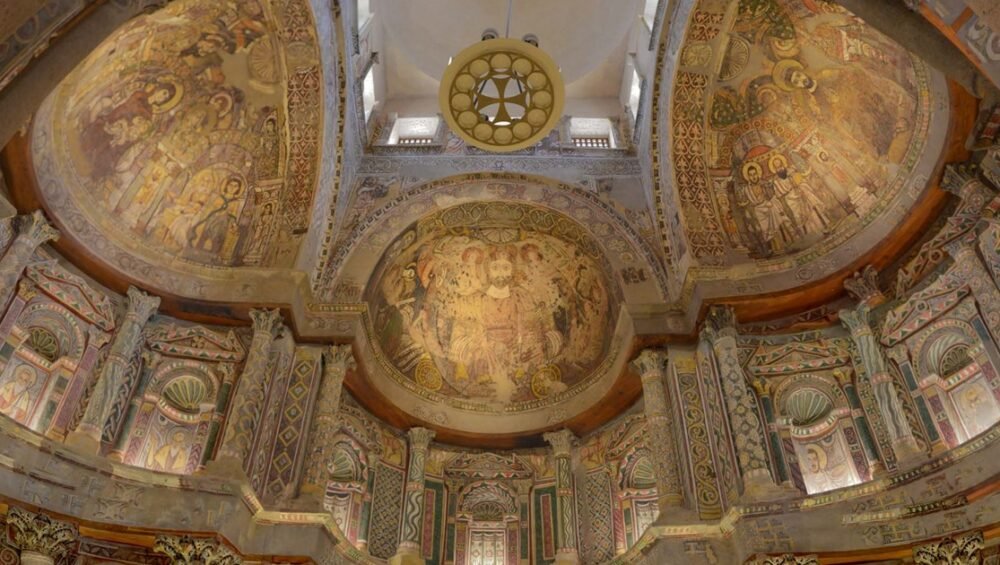
In contrast to its stark, fortress-like exterior, the Red Monastery’s interior reveals a world of intricate frescoes and painted reliefs. These decorations, among the most complete and best-preserved of any Late Antique church, date back to between the 5th and 7th centuries. Thanks to recent conservation efforts, visitors can once again witness the extraordinary geometric patterns, angelic portraits, and biblical scenes that adorn every corner. The artistry reveals clear connections to early Byzantine influence, making it a cornerstone for scholars studying Coptic art and architecture. For a deeper look into Egypt’s extraordinary sacred architecture, you may also explore the Temple of Seti in Abydos, which shares the same spiritual region of Sohag.
Architectural Brilliance: A Fortress of Faith
The Red Monastery’s architecture is a marvel of engineering, blending military-inspired design with sacred intention. Built of fired red bricks—which gave the structure its name—the monastery’s outer walls feature thick, buttressed forms designed to safeguard the monastic community from desert raids. Inside, the triconch-shaped sanctuary stands as a masterpiece of early Christian design, echoing Roman basilicas while preserving distinct Coptic features. Column shafts of blue marble, Corinthian capitals, and painted arcades emphasize both strength and grace. The effects of light filtering through narrow clerestory windows give the church a celestial ambiance, as if heaven itself blesses the worshippers below.
This iconic sanctuary reveals how early Egyptian builders combined aesthetics and devotion. The narthex, nave, and triple apses form a symbolic journey from earth to heaven. Much like the vivid splendor of the Luxor Temple, which narrates Egypt’s pagan past, the Red Monastery celebrates its Christian rebirth in brilliant shades of pigment and texture. Many travelers exploring ancient Egypt on a Luxury Nile Cruise make a special stop at Sohag to witness this architectural time capsule first-hand.
Artistic Frescoes: A Gallery of Sacred Stories
Stepping into the Red Monastery feels like entering a living icon. The walls are covered with vivid frescoes depicting saints, angels, apostles, and intricate biblical scenes painted in red, blue, and gold hues. These artworks have survived through centuries of abandonment, weathering, and war. Restoration projects spearheaded by international teams have brought to life hundreds of details once hidden under soot and decay. Layers of history are visible—each brushstroke whispering devotion from Egypt’s early Christians. The monastery’s colors and geometric forms create a spiritual rhythm unmatched in the Coptic world, rivaling even the charm of decorated tombs in Upper Egypt’s necropolises.
For art lovers exploring Egypt’s hidden wonders, pairing a visit to Sohag with cultural landmarks like the Coptic Museum in Cairo or the splendid Hanging Church offers an exceptional insight into the evolution of Christian art from the Roman era to modern Coptic traditions.
Monastic Life and Spiritual Legacy
During its peak, the Red Monastery was part of a thriving ascetic community. Monks here lived lives of strict contemplation, fasting, and manual labor, while copying sacred manuscripts that strengthened Egypt’s religious scholarship. Though centuries have passed, the spiritual atmosphere endures. The chanting of prayers echoes through corridors of baked brick, connecting today’s Coptic believers to those of centuries past. The monastery remains active, occasionally hosting liturgical services and drawing faithful pilgrims from across Egypt and beyond. Combined with visits to monasteries in Wadi El Natrun or St. Catherine’s Monastery in Sinai, the Red Monastery completes the pilgrimage circuit of Egypt’s most venerated Christian sites.
The Red Monastery’s Modern Revival
For decades, the Red Monastery languished under neglect; its ceiling cracked, frescoes dimmed, and walls weakened. However, in the late 20th and early 21st centuries, comprehensive restoration led by the American Research Center in Egypt revived this spiritual landmark. Engineers, archaeologists, and conservators meticulously cleaned the frescoes, consolidated brickwork, and stabilized the foundations. The results were breathtaking—revealing paintings so rich they transformed our understanding of early Christian aesthetics. The restoration, completed in partnership with the Egyptian Ministry of Antiquities, repositioned the Red Monastery as one of the most visually stunning religious monuments in Africa.
Visitors arriving through regional excursions or as part of Egypt Day Tours can explore the monastery’s church, ancient cells, and restored apse adorned with columns and murals. Combining the trip with excursions like a Day Tour to Pyramids, Memphis and Sakkara lets travelers experience both Pharaonic and Christian milestones in Egyptian history.
Visiting the Red Monastery Today
Located just north of Sohag city, the Red Monastery is easily accessible by car or through organized tours connecting Upper Egypt’s heritage trail. It pairs beautifully with cultural stops at the White Monastery and the rich archaeological zones of Abydos. Architecture enthusiasts, photographers, and spiritual travelers will find endless inspiration here—the harmony between ancient craftsmanship and divine creativity is palpable. The colors, restored to near-original brilliance, speak of a time when art was both devotion and expression. Beyond its visual splendor, the site serves as a symbol of perseverance for Egypt’s Christian minority, whose heritage continues to shape national identity.
Tourists often include the Red Monastery within multi-day Upper Egypt routes curated under programs such as 8 Days Best Egypt Tour with Nile Cruise or 6 Days Cairo to Luxor Tour, weaving a perfect narrative between ancient faith and timeless art. And for adventurous travelers, linking Sohag visits with spiritual oases like the Abu Simbel Temples or Aswan’s Temple of Philae adds depth to any cultural journey.
Preservation and Cultural Importance
In 2015, following years of conservation, the Red Monastery reemerged as a beacon of faith and art. UNESCO and academic circles hailed the site for its unparalleled iconographic preservation. It represents not only Egypt’s Christian heritage but also the enduring connection between art and spirituality across civilizations. Scholars trace cross-cultural influences between Coptic frescoes and Byzantine mosaics, offering insights into how Egyptian monks absorbed and reinterpreted global artistic trends. The Red Monastery thus transcends religion—it’s a universal monument to creativity born from devotion.
Travelers intrigued by ancient spirituality can extend their journey to explore Egypt’s desert hermitages or embark on a 7 Days Cairo, Luxor, Abu Simbel & Sahara Trip, discovering monastic ruins and desert sanctuaries where solitude and faith still reign supreme. The Red Monastery’s story, like the sands around it, remains timeless.
FAQs About the Red Monastery
Where is the Red Monastery located?
The Red Monastery lies about ten kilometers northwest of Sohag city in Upper Egypt, near the Nile’s west bank. Surrounded by desert plains, it forms part of a broader monastic complex that includes the White Monastery. Travelers can reach it easily by local transport or as part of organized cultural tours visiting Egypt’s Coptic landmarks.
Who founded the Red Monastery?
The Red Monastery was founded in the 4th century by Saint Pishay (Anba Bishai), a disciple of Saint Shenouda the Archimandrite. Together, these spiritual leaders established one of the most important centers of early monastic life in Egypt.
Why is it called the Red Monastery?
The name stems from the distinctive reddish brick used in its construction. The burnt clay hue not only gives the walls their characteristic tone but also distinguishes the monastery from its limestone-built counterpart, the nearby White Monastery.
Can visitors tour the inside of the Red Monastery?
Yes, visitors can tour the interior of the monastery, including the restored sanctuary and its spectacular frescoes. The site is open to tourists and pilgrims, usually as part of guided excursions arranged within heritage-focused or Luxury Egypt Tours.
What is the best time to visit the Red Monastery?
The best time to visit is during the cooler months between October and April when temperatures in Upper Egypt are pleasant for exploration. Early morning light beautifully highlights the reddish tones of the monastery’s exterior, ideal for photography enthusiasts seeking captivating compositions.
How does the Red Monastery contribute to Coptic heritage?
It serves as a living monument of early Christian Egypt, preserving art, architecture, and monastic traditions that shaped the spiritual identity of the Coptic Church. The frescoes and structural design exhibit continuity between ancient Egyptian, Greco-Roman, and Christian artistic philosophies, symbolizing a bridge between worlds and eras.
Are there nearby attractions worth visiting?
Yes, visitors can explore the White Monastery, the city of El Minya, and sites such as Abydos and Dendera Temple Complex. For broader itineraries, pairing these visits with Luxor City or Aswan City makes an unforgettable pilgrimage across Egypt’s sacred landscapes.