
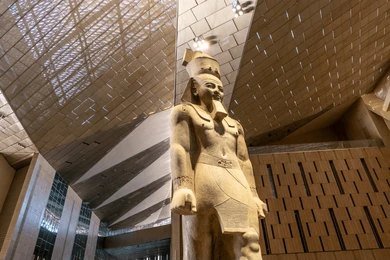
Statue of Ramses II – A Majestic Legacy of Egypt’s Eternal Pharaoh
The Statue of Ramses II stands as an extraordinary testament to the grandeur and power of ancient Egyptian civilization. Carved with precision and awe-inspiring artistry, this masterpiece immortalizes one of Egypt’s most illustrious rulers, Ramses II, also known as Ramses the Great. His reign, which spanned more than six decades during the 19th Dynasty, marked a golden age of prosperity, military triumphs, and monumental construction. The colossal statue, once towering majestically at the entrance of temples and cities, was a vivid declaration of Ramses II’s divine kingship and his unyielding authority over the ancient world. Today, it remains one of the most celebrated symbols of pharaonic Egypt, evoking admiration from historians, travelers, and art enthusiasts across the globe.
Standing over 10 meters tall and weighing more than 80 tons, the Statue of Ramses II was sculpted from a single block of limestone. Its grand scale captures not only the physical attributes of the pharaoh but also the divine aura he projected. The statue’s serene yet commanding expression reflects the Egyptian ideal of kingship—a ruler who harmonized strength, wisdom, and divinity. Originally, several of these monumental statues were strategically placed in temples such as Abu Simbel and Thebes to showcase both the artistic mastery and spiritual devotion of ancient Egypt. Today, one of the most famous examples of this statue can be found at Memphis, the ancient capital of Egypt, where it continues to captivate visitors worldwide.
Ramses II’s imposing image was not merely decorative—it was propaganda in stone, crafted to project an image of immortal splendor. The pharaoh’s face radiates calm confidence, his back straight and shoulders broad, embodying eternal stability. Even centuries after his reign, his statues influenced Egyptian art and royal iconography. Tourists visiting Egypt on cultural expeditions or Egypt Private Tours often include the Statue of Ramses II on their itineraries to witness firsthand this eternal icon of ancient majesty.
The Historical Background of Ramses II – Pharaoh of Power and Glory
Ramses II, the third pharaoh of the 19th Dynasty, ruled Egypt from 1279 to 1213 BCE and is often hailed as Egypt’s greatest monarch. Known for his military exploits, architectural wonders, and prolific building campaigns, Ramses II transformed Egypt into a colossal empire that extended its influence across Nubia and the Levant. His reign brought forth an artistic renaissance, best exemplified by his statues, temples, and monuments that dotted the Nile Valley. Scholars attribute many great feats to his leadership, including the construction of the Ramesseum—a vast mortuary temple on the west bank of Luxor dedicated to his eternal worship—and the magnificent Abu Simbel Temples in Nubia.
Ramses II was also a shrewd politician, famously signing the world’s first recorded peace treaty with the Hittites after the fierce Battle of Kadesh. This act of diplomacy not only secured Egypt’s borders but also reinforced Ramses’s image as a wise and divine ruler. His likeness, replicated in countless statues, underscored his status as “Son of Ra”—the living god on earth. Visitors exploring the west bank of Luxor during Luxor Day Tours often marvel at his temple memorial and the colossal figure that once graced its entrance—the very foundation of his legend.
The Statue’s Artistic Design and Symbolic Meaning
The Statue of Ramses II embodies idealized royal features that symbolize divine perfection. His symmetrical facial features, full lips, and almond-shaped eyes are framed by the royal nemes headdress, often adorned with the uraeus—symbol of sovereignty and protection. The broad chest and forward-gazing posture signify power and vigilance. Artists of the time did not merely sculpt a portrait; they captured the metaphysical essence of kingship.
The pharaoh’s hands often rest on his knees or hold ritual symbols like the crook and flail, denoting his dual role as protector and provider. Hieroglyphic inscriptions carved into the throne or base of the statue offer praises to Amun-Ra and immortalize Ramses’s titles. Each curve and proportion conveys political messaging—authority blended with divine legitimacy. Many Egyptologists highlight how Ramses’s statues epitomize the Egyptian philosophy of eternal life, where the soul’s immortality was physically anchored through colossal representations like this.
From Memphis to Cairo – The Journey of the Statue of Ramses II
The Statue of Ramses II was discovered at the ancient city of Memphis Egypt, The Old Egyptian Capital, lying face down in the sand for centuries before being brought to international attention in the mid-20th century. Its rediscovery sparked global excitement, revealing not just a statue but a cultural artifact that bridged the gap between modern and ancient Egypt. For years, the statue stood at Ramses Square in Cairo, where millions passed by this magnificent icon daily.
However, due to increasing pollution and urban congestion, Egyptian authorities decided to relocate the statue to a safer, more befitting environment. After a meticulous and celebrated transport operation, the colossus was moved to the new Grand Egyptian Museum near the Pyramids of Giza. Today, it welcomes visitors at the museum’s grand entrance hall, symbolizing Egypt’s unbroken link to its glorious past. Tourists enjoying Cairo Day Tours or Day Tours to the Pyramids & the Nile often include a stop at this museum to witness the majestic colossus up close.
Cultural and Political Significance of the Statue
The Statue of Ramses II wasn’t simply an artistic endeavor—it served as a political instrument of divine kingship. Every monumental statue erected under his reign reinforced the principle of “Ma’at”–the Egyptian concept of cosmic order and balance. Through enormous depictions of himself, Ramses II communicated his eternal control over the land, uniting the divine and mortal realms. His statues also served to intimidate foreign envoys visiting Egypt, standing as a colossal representation of power and endurance.
Modern Egyptologists argue that Ramses II’s prolific use of self-images was a calculated act of immortality branding. His face became one of the most recognizable across the ancient world, often replicated across temples from Abu Simbel to Luxor. The Ramesseum Temple remains an outstanding example of this philosophy, with fragments of colossal statues still scattered in situ—a poetic reminder of timeless ambition.
The Preservation and Restoration of the Statue
The relocation of the Statue of Ramses II required remarkable engineering and conservation expertise. Specialists worked tirelessly to restore damaged features, remove centuries of grime, and stabilize the stone structure. Preservation efforts reflect modern Egypt’s commitment to protecting its heritage while introducing it to global tourism. The current display setting provides optimal lighting and environmental control, enhancing both visual appreciation and cultural education.
Archaeological experts cooperate closely with exhibitions and academic programs under cultural initiatives similar to Luxury Egypt Tours programs, ensuring ongoing awareness about Ramses II’s legacy. Through scholarly studies and 3D modeling, researchers continue to reveal hidden symbols and inscriptions embedded in the statue’s core, further deepening our understanding of its original context.
Ramses II’s Lasting Influence on Egyptian Art and Architecture
The influence of Ramses II extended far beyond his lifetime. His grand construction projects redefined the aesthetic landscape of Egypt. The colossal scale of his statues inspired later pharaohs, kings, and even modern sculptors, setting the template for royal portraiture and monumentality. His commitment to monumental art served both spiritual and political purposes, reverberating through centuries of Egyptian history.
From the temples along the Nile to sites like Abu Simbel Temples and Temple of Philae, Ramses II’s architectural genius stands unmatched. Scholars often compare his building projects to the later wonders of the Greco-Roman world. Even in modern Egypt, the statue remains an emblem of national pride, included in numerous cultural tourism experiences like Egypt Day Tours and educational exhibitions.
Visiting the Statue of Ramses II Today
Visiting the Statue of Ramses II is a profound experience, offering travelers an authentic encounter with Egypt’s royal legacy. Its current placement inside the Grand Egyptian Museum makes it accessible to millions, from historians and students to families on Egypt Family Tours. The statue’s sheer scale dwarfs visitors as they gaze upward, a visual metaphor for the enduring might of Pharaoh Ramses the Great.
For a deeper dive into ancient Thebes, tourists can extend their journey with Aswan Day Tours or Luxury Nile Cruises, tracing Ramses’s architectural footprint along the river. Egypt’s Ministry of Tourism ensures guided preservation programs, making this encounter both educational and sustainable for generations to come.
FAQs About the Statue of Ramses II
1. Where is the Statue of Ramses II located today?
The Statue of Ramses II is now prominently displayed at the Grand Egyptian Museum near the Giza Pyramids. It was moved from Ramses Square in Cairo to provide it with a preserved and monumental display environment suitable for its cultural importance.
2. How old is the Statue of Ramses II?
The statue dates back over 3,200 years to the reign of Ramses II during Egypt’s 19th Dynasty, around the 13th century BCE. It remains one of the best-preserved and most famous sculptures of the pharaonic era.
3. What materials were used to make the Statue of Ramses II?
The statue was crafted from limestone and sometimes granite, materials chosen for their durability and symbolic connection to eternity. Many of Ramses II’s other statues were similarly carved from sandstone or granite sourced from Aswan quarries.
4. Why was Ramses II considered a great ruler?
Ramses II earned his title as Ramses the Great due to his military skill, monumental building programs, and unprecedented 66-year reign. His peace treaty with the Hittites and projects like Abu Simbel demonstrate his mastery of diplomacy and engineering alike.
5. Can I see the Statue of Ramses II during my trip to Egypt?
Absolutely! Most Egypt Vacation Packages and All Inclusive Egypt Vacations include visits to the Grand Egyptian Museum, where the statue stands as a highlight of the tour. It’s a breathtaking experience that evokes the awe of ancient glory.