St. Catherine’s Monastery: The Sacred Heart of Sinai and the World’s Oldest Active Monastery
Hidden where the majestic slopes of Mount Sinai meet the endless desert, St. Catherine’s Monastery in Egypt isn’t just a religious complex—it’s a living time capsule that whispers tales of faith, heritage, and divine mystery. Nestled at the foot of Jebel Musa, this UNESCO World Heritage Site stands as the oldest continuously functioning Christian monastery in existence. Built in the 6th century under the orders of Emperor Justinian I, it’s both a symbol of enduring devotion and a sanctuary of worldwide religious significance. Pilgrims, historians, and explorers from around the globe travel to this remote location to marvel at its treasures, architectural wonder, and spiritual resonance.
What makes St. Catherine’s Monastery utterly fascinating isn’t just its remarkable age, but its unique coexistence of cultures and beliefs. Within its fortress-like walls thrive ancient icons, early Christian manuscripts, and a centuries-old tradition of hospitality. For any visitor pursuing a once-in-a-lifetime encounter with the soul of the Sinai Desert, this extraordinary site is a must-see destination that combines history, spirituality, and breathtaking scenery in one unforgettable experience. Every stone in this sacred monastery tells a story of resilience, unwavering faith, and human connection—a narrative deeply intertwined with the journey of mankind itself.
The Spiritual and Historical Foundation of St. Catherine’s Monastery
St. Catherine’s Monastery was constructed between 548 and 565 AD on the command of Byzantine Emperor Justinian I. It was designed to protect the Chapel of the Burning Bush, believed to mark the very spot where Moses heard the voice of God. The holy ground where the monastery stands is considered one of the most sacred Christian pilgrimage sites. Interestingly, it also holds deep reverence within Judaism and Islam, connecting the Abrahamic faiths through shared stories and sacred origins. The monastery’s official name is the Sacred Monastery of the God-Trodden Mount Sinai, underscoring its divine status.
Inside, the monastery is home to an astonishing library—rivaled only by the Vatican in its ancient manuscript collection. Here, you’ll find handwritten Gospels, rare Greek and Syriac texts, and some of the earliest biblical codices known to man. The site was later named after St. Catherine of Alexandria, a revered martyr whose relics were said to have been miraculously transported by angels to the mountain. For centuries, monks residing here have preserved the same traditions, prayers, and rituals, continuing an unbroken legacy that defines Christian monasticism.
Architectural Marvels in Stone and Faith
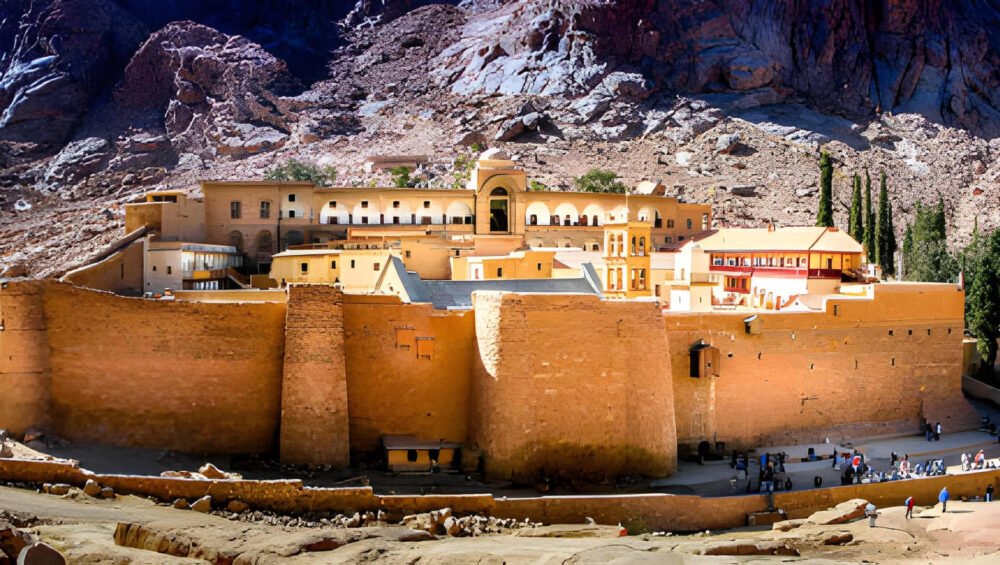
The walls of St. Catherine’s Monastery rise high and thick, built for protection during times when nomadic tribes roamed the Sinai Peninsula. The architecture blends Roman, Byzantine, and early Christian influences, forming a structure that’s part fortress, part spiritual haven. The granite walls contain chapels, a basilica, and living quarters for monks, all constructed with meticulous craftsmanship. Within the Basilica of the Transfiguration, visitors encounter ornate mosaics depicting Christ in divine glory—a masterpiece of Byzantine art that has withstood the passage of centuries.
Each element—from the arched doorways to the ancient olive trees—is steeped in symbolism. The monastery even includes a small minaret, reflecting its long history of coexistence with neighboring Bedouin tribes and Islamic pilgrims. The result is a living example of religious harmony that transcends borders and ideologies. Many spiritual travelers who embark on Mount Sinai & St. Catherine Monastery tours find that this architectural symphony leaves a lasting impact on their souls.
The Chapel of the Burning Bush: Faith Set Aflame
Among the many sanctuaries inside the monastery, none is as iconic as the Chapel of the Burning Bush. Tradition holds that this very site is where Moses first encountered the divine flame, hearing the command to lead the Israelites out of Egypt. The Chapel houses what is said to be the descendant of that miraculous bush, a living symbol of God’s eternal presence. Pilgrims often remove their shoes before entering, in respect for this hallowed ground, just as Moses did thousands of years ago. The energy here feels almost tangible—quiet, yet overwhelmingly powerful.
It’s this sacred connection to the story of Exodus that gives the monastery its extraordinary spiritual weight. From dawn prayers echoing through stone corridors to the soft flicker of oil lamps illuminating ancient icons, every moment within the Chapel of the Burning Bush feels untouched by time. Visitors often combine their experience here with a sunrise climb of Mount Sinai tours from Sharm El Sheikh to witness the first light sweeping across the desert peaks, a moment that feels as transcendent now as it did in biblical times.
The Priceless Treasures and Religious Relics
The monastery’s treasury is a dazzling exhibition of faith’s material heritage. Precious icons painted in the earliest Christian centuries still glow with gold leaf and divine imagery. Silver crosses, reliquaries containing saintly remains, and intricate chalices are meticulously preserved. Perhaps the most significant collection, however, is the ancient library containing nearly 3,000 manuscripts and 5,000 early printed books, spanning Greek, Coptic, Arabic, Georgian, and other languages. It includes the celebrated Codex Sinaiticus, one of the earliest complete manuscripts of the Christian Bible.
Despite its remote location, St. Catherine’s Monastery has managed to maintain these treasures through centuries of turmoil and isolation. Monks have traditionally served as the custodians of interfaith peace, their kindness extending to Muslim pilgrims as well. Historical records even reveal a signed protection decree from Prophet Muhammad himself, ensuring the safety of the monastery and its inhabitants. Today, this spirit of coexistence continues to define the monastery as a sanctuary of humanity’s shared spiritual legacy.
Life Inside the Ancient Monastery Walls
The monks at St. Catherine’s lead lives of simple devotion, prayer, and service. Their daily routines reflect centuries-old monastic traditions—morning prayers in the basilica, maintenance of gardens and olive trees, recording texts by hand, and offering hospitality to any visitor seeking solace. Pilgrims often describe their encounters here as humbling and contemplative, merging faith and nature in an extraordinary environment. The monks’ resilience in preserving both their sacred duties and cultural artifacts serves as an inspiration for those who visit seeking peace in a chaotic world.
Outside the monastery, the surrounding desert hums with silence, punctuated only by the songs of birds and the rustle of wind. Visitors who travel on Sharm El Sheikh Day Tours or cultural excursions through Sinai and the Red Sea often remark how the serenity of this sacred place feels unmatched anywhere else on earth. The experience is otherworldly—an intersection of earth’s ancient past and heaven’s promise of eternity.
Visiting St. Catherine’s Monastery: An Experience Beyond Time
Getting to St. Catherine’s Monastery is an adventure in itself. Located at the heart of the South Sinai, approximately 230 km from Sharm El Sheikh, it can be reached by organized tours or private transfers. Travelers usually combine their visit with a climb of Mount Sinai to witness the world-famous sunrise from the summit. Once at the monastery, modest attire and respectful behavior are essential, as it’s still an active site of worship. Photography of certain relics and icons may be restricted, preserving their sanctity and mystery.
For an in-depth experience, travelers often include the monastery as part of a broader Egypt vacation package. Whether through historical expeditions, luxury Egypt tours, or cultural treks through desert landscapes, this journey always leaves an indelible mark. From the moment visitors lay eyes on the towering monastery gates until they step back into the desert sunlight, they feel transformed, spiritually and emotionally, by a timeless harmony blending faith, art, and endurance.
Interesting Facts About St. Catherine’s Monastery
One of the most remarkable facts about St. Catherine’s Monastery is that it houses its own micro-community—the smallest autonomous diocese in the world. The monks are Greek Orthodox, but their daily lives bridge Egyptian, Bedouin, and international communities. Another notable feature is the presence of an ancient mosque inside the fortress, symbolizing religious coexistence. The architecture and library attract not just theologians and pilgrims but also archaeologists, art historians, and linguists eager to explore its multifaceted legacy.
Moreover, pilgrims exploring St. Catherine and Colored Canyon by Jeep tours often combine spiritual exploration with adventure, driving through surreal desert canyons and visiting Bedouin settlements to grasp the isolation and devotion that define this region. This journey reveals how the monastery remains not just a center of faith, but a living embodiment of the connection between humankind and the divine.
FAQs About St. Catherine’s Monastery
1. Why is St. Catherine’s Monastery important?
St. Catherine’s Monastery is the world’s oldest continuously active Christian monastery, built over the site of the biblical Burning Bush. It’s significant for its spiritual history, ancient manuscripts, and its role as a symbol of coexistence between Christianity, Judaism, and Islam.
2. Who founded St. Catherine’s Monastery?
The Byzantine Emperor Justinian I commissioned the construction of the monastery in the 6th century to protect monks and the Chapel of the Burning Bush, creating a fortified religious sanctuary that endures to this day.
3. What can visitors see inside St. Catherine’s Monastery?
Inside, visitors can admire the Basilica of the Transfiguration, the Chapel of the Burning Bush, the sacred library, and a collection of priceless religious icons and relics. The courtyard and gardens offer peaceful spaces to reflect amid the arid majesty of Sinai.
4. How do I get to St. Catherine’s Monastery?
Most travelers reach the monastery from Sharm El Sheikh or Dahab through guided excursions such as the Mount Sinai & St. Catherine Monastery tour. The journey includes scenic drives across the rugged Sinai landscape and optional dawn climbs to the mountain’s summit.
5. What makes the monastery’s library special?
The library of St. Catherine’s Monastery holds one of the largest and oldest collections of Christian manuscripts, second only to the Vatican. These precious texts preserve knowledge in Greek, Syriac, Arabic, and Coptic, representing the intellectual pulse of early Christianity.